Tag: posture

  • 541. Wednesday Q&A: Tingling Palms, Clunky Movement & Connecting with Your Glutes

    Welcome to Wednesday Q&A, where you ask questions and we answer them!

    In this Wednesday Q&A, we answer your questions about palm tingling, back pain for mothers, feeling clunky, and connecting with your glutes.


    Your questions:

    • I’m experiencing tingling in the palm of my hand on occasion. What could that be and what should I do?
    • I have a client who has back pain. She’s also a mother of three and is currently breastfeeding. Any tips?
    • You both move with such ease. How do you recommend others move who feel more clunky in their bodies?
    • I feel like I have no connection with my glutes. Any recommendations?


    To learn more, and for the complete show notes, visit: lytyoga.com/blog/category/podcasts/


    Do you have a question?


    Sponsor:


    Redefining Yoga is produced and published by Crate Media.

  • 540. The Breath-Body Connection with Campbell Will

    Campbell Will is a physiotherapist and the founder of BreathBody Therapy. He’s had a lifelong fascination with how the human body works. As he began to understand the functions of it, he came to realize that a large part of what makes the body work well is our breathing.

    We talk about looking at the body as a whole system, how breath connects to seemingly unrelated injuries, breathing appropriately for the situation, changing the behavior pattern of non-optimal breathing, and the power of breath retention.


    Resources:

  • 539. Wednesday Q&A: Arm Straightening, Tight Piriformis & Bound Hip Flexors

    Welcome to Wednesday Q&A, where you ask questions and we answer them!

    In this Wednesday Q&A, we answer your questions about lack of shoulder flexion, releasing the piriformis, moves for bound hip flexors, and our thoughts on massage guns.


    Your questions:

    • I have a client that struggles to get the arms straight when lifting them overhead. The elbows tend to bend outwards. I’m not sure how or where to focus to improve this. Any thoughts?
    • How do you release the piriformis? They burn after an active day of work or household chores.
    • What are some moves that can help with bound hip flexors?
    • Thoughts about massage guns?


    To learn more, and for the complete show notes, visit: lytyoga.com/blog/category/podcasts/


    Do you have a question?


    Sponsor:


    Redefining Yoga is produced and published by Crate Media.

  • Upper Extremity Nerve Glides

    Upper Extremity Nerve Glides

    If you’ve ever heard me talk about nerves, I like to describe them as telephone wires. I visualize how these wires have a decent amount of slack on them as they traverse from pole to pole, transmitting countless conversations along the way. I will see birds come to perch and wonder if there’s a breaking point to where the slack needed to transmit the electrical impulse is no longer available due to the weight of the birds along the way. The nerves in our bodies can be visualized in much the same way. They need freedom to move and glide, with enough just slack to allow the neural impulses to travel from the brain to the body and back. It’s not uncommon to have areas of impingement along these nerves, which can cause a whole host of issues including sensory changes, weakness, and pain. I imagine those areas of impingement as birds sitting on that wire, taking up slack and causing tension. These “birds” can be anything from disc bulges, bone spurs, tight muscles, poor posture, to restricted soft tissues, etc. It’s my job as a physical therapist to remove as many of these birds from the wire, especially if they’re causing pain. 


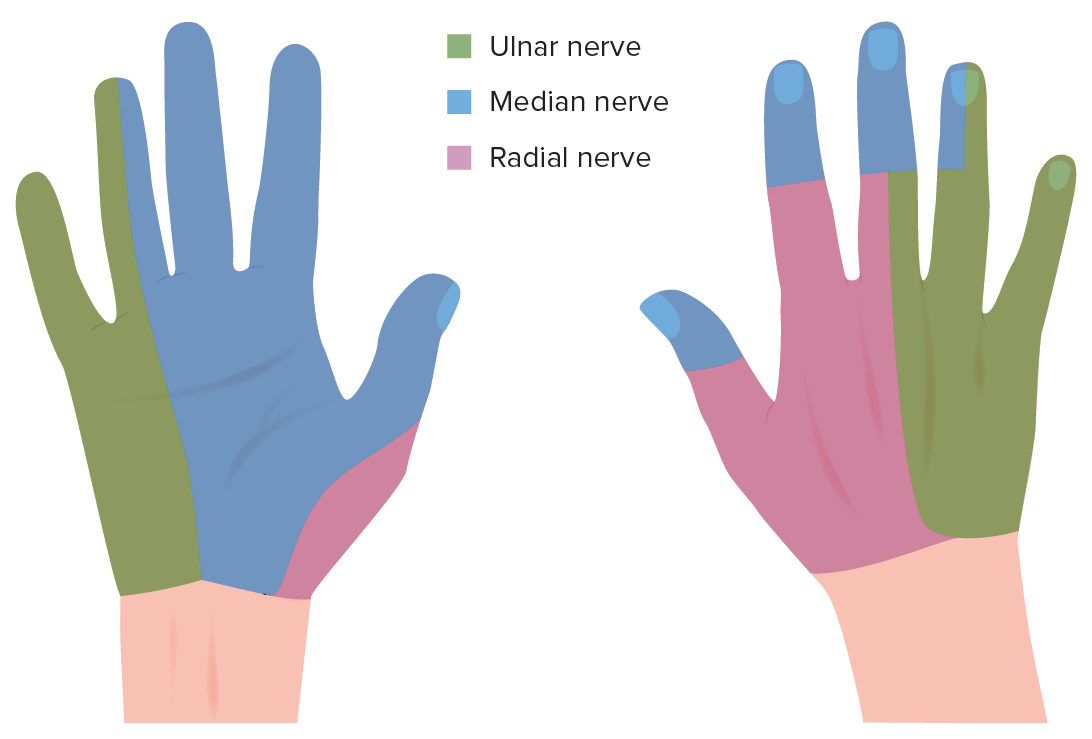
    A common place people will experience nerve impingement symptoms is in the neck and arms. We have a bundle of nerves coming from our neck into our upper extremities called the brachial plexus, which exits the neck and splits into five nerve branches in the arm: the axillary, musculocutaneous, median, radial, and ulnar nerves. For the purposes of this PT Corner, we are just going to discuss the median, radial, and ulnar nerves, as these are the nerves we most commonly treat when it comes to nerve impingement syndromes. 


    The median nerve runs down the inside of the arm and through the center of the forearm and wrist. It is probably the most well-known of the three, as when it is impinged, people may develop something called carpal tunnel syndrome. The median nerve provides sensation to the palm of the hand, palm side of the thumb, index, middle, and half of the ring finger, and ends of the back side of the thumb, index, middle, and half of the ring finger. It innervates the muscles that pronate the forearm, flex the wrist and fingers, and abduct the hand. 


    The radial nerve runs more along the back of the arm before wrapping around the thumb side of the forearm to the thumb side of the hand. It provides sensation to the posterolateral upper arm, the posterolateral forearm, lateral side of the base of the thumb, and thumb side half of the back of the hand, and back side of the thumb, index and half of the middle finger. It innervates the muscles that flex and extend the elbow, supinate the forearm, extend the wrist and fingers, and move the thumb. 


    Finally, the ulnar nerve runs along the inside of the arm, inside of the elbow, and down the pinky side of the forearm to the pinky side of the hand. It’s the nerve you feel when you hit your “funny bone”. The ulnar nerve provides sensation to the pinky side of the hand, front and back, including the entire pinky and half of the ring finger. It innervates the muscles that flex the wrist and fingers, move the pinky, and adduct the thumb.


    Nerve gliding or mobilizing is one way to take “a bird off the wire”, by restoring homeostasis in and around a nerve. It is believed to decrease pain caused by entrapment of a nerve by encouraging movement between nerves and their surrounding structures. These nerve glides can be manual techniques performed by a healthcare professional on a patient or by the patient themselves. Studies have shown that mobilizing a nerve can decrease edema (swelling) and improve fluid dispersion within a nervous structure, reduce pain, and reverse the increased immune responses following a nerve injury. When mobilizing a nerve, you do not want to irritate or stretch the nerve. Just imagine that you are flossing the nerve along the path it follows from the head to the arm, freeing up any areas of entrapment. Here are some simple beginner nerve glide exercises for the upper extremities, which can be done on your own:


    • Median Nerve Glide – begin with your arm at your side, palm facing forward; you can place the opposite hand on the space between your neck and shoulder as an anchor; slowly flex and extend your wrist. Repeat 10-20 times.
    • Radial Nerve Glide – begin with your arm at your side, palm facing back; you can place the opposite hand on the space between your neck and shoulder as an anchor; extend the arm slightly behind you; slowly flex and extend your wrist. Repeat 10-20 times.
    • Ulnar Nerve Glide – extend your arm out to the side with the elbow bent to 90 degrees and your palm facing your face; you can place the opposite hand on the space between your neck and shoulder as an anchor; slowly flex and extend your wrist. Repeat 10-20 times.


    You can find a demonstration of these glides and some more advanced versions on our YouTube channel by clicking the link below! As always, seek the help of a physical therapist or other healthcare professional if symptoms progress or do not improve. Let’s keep those nerves moving and grooving so I can keep seeing you on the mat! 


    Xoxo,

    Kristin

  • “Sciatica” or Gluteal Radiculopathy?

    “Sciatica” or Gluteal Radiculopathy?

    by Sarah Kingsley


    Have you been diagnosed with “sciatica?” Although a common back issue, many doctors are quick to diagnose these vague back, hip, and leg pains as sciatica when it may not be the case. Much less discussed, and susceptible to irritation – if not more so in modern society – are the superior and inferior gluteal nerves.


    Sciatica is a term coined for pain that radiates along the path of the sciatic nerve. This nerve begins in your lower back L4-S3, branches through your hips and buttocks and down into each leg, behind the knee, and into the calf.  According to Mayo Clinic, “sciatica most commonly occurs when a herniated disk, bone spur on the spine or narrowing of the spine (spinal stenosis) compresses part of the nerve, causing inflammation, pain and often some numbness in the affected leg.” Symptoms include pain that radiates from the lower (lumbar) spine to the buttock and down the back of the leg. The pain varies in intensities from a mild ache to a sharp, burning sensation, excruciating pain, or jolt. It can be aggravated with prolonged sitting, coughing, and sneezing.  The sciatic nerve innervates the hamstring muscles that flex the knee, causing weakness of bending the knee when irritated. 


    The culprit of most back pain-related issues is poor posture! Sitting or standing for prolonged periods in a rounded spine position can lead to compression and restriction in the muscles, joints, and disc spaces. When going to stand or change positions quickly with shortened hip flexors or hamstrings, the back overly extends in compensation, compressing the sciatic nerve. 


    Performing any lifting tasks with poor body mechanics and lack of core activation to support the structures around the spine can irritate the nerve. This action overly activates the spinal extensors when coming back upright, as opposed to utilizing the gluteals, leading to disc compression that can send symptoms down into the leg. Sitting, standing, or walking with your toes pointed outwards and hips externally rotated can also decrease piriformis muscle length. For most people, the sciatic nerve runs directly through this muscle and when restricted, can lead to nerve irritation.


    Treatment includes variations of sciatic nerve glides/flossing techniques to increase circulation to the nerves and decompress the tissues that surround the joints and muscles. These techniques include stretching and soft tissue mobilization of the piriformis, hamstrings, and hip flexor muscles. Forms of spinal traction can also be useful, decreasing pressure on the nerve done manually by a therapist, use of a traction device, or by using one’s own hands on the thighs as done in many of our LYT classes.


    For effective management, the decompression must be combined with retraining the activation of the deep core and gluteal musculature to prevent excessive strain and overuse of the spinal extensors. Exercises to target these muscles and retraining the hip hinge strategy for squatting, bending, and lifting is key to keep the back and sciatic nerve happy.


    In severe cases, a cortisone injection can decrease the nerve inflammation. However, the effects of these injections are short-lived and come with side effects including bone degradation. Learning the tools to manage these symptoms with proper exercises and movement patterns is what will ultimately promote long-term pain relief and symptom management.


    The superior and inferior gluteal nerve branches off just before the sciatic nerve from L4-S1. They supply the gluteus maximus, medius, gluteus minimus, tensor fascia lata, and piriformis muscles that are responsible for hip extension, hip abduction (moving out to the side), internal and external rotation, and flexion. Symptoms often include difficulty climbing stairs and rising from a sitting to a standing position. Other symptoms include a deep aching pain and a “trendelenberg gait” pattern, which is when one’s hip drops down to the side.


    This injury can often occur after a hip replacement surgery or trauma. There is a higher risk of injury to the superior gluteal nerve when the hip is placed in lesser degrees of flexion and adduction during surgical nailing. Lack of proper strengthening to the hip abductor muscles and entrapment or restriction of the piriformis muscle have also been known to cause these symptoms. The immense amount of time we spend in the seated position often leads to compression and deactivation of the gluteal muscles and the nerves that supply them.


    Gluteal nerve irritation is treated very similarly to the sciatic nerve, focusing on deep core and gluteal activation, proper body mechanics, and hip hinge retraining. However, a greater emphasis is placed on mobilizing the hip joint and the surrounding tissues to increase range of motion for all hip movements to reduce typical compensations at the back and pelvis. Compensation at the pelvis can contribute to a restricted quadratus lumborum (which is our hip hiking muscle), so manual and stretching release techniques to this region can also be useful. Opening of the joints and soft tissue spaces, combined with strengthening the gluteals and hip muscles for good hip movement without pelvic compensation is key for long-term pain management.


    Be sure to check out Kristin Williams’ sciatica series on LYT daily and Lara’s Calm the QL Quarrel class for some ideas!

  • Feedback Friday with Margaux Delemasure

    Feedback Friday with Margaux Delemasure


    Margaux is an experienced LYT practitioner and teacher who wanted some feedback for fine tuning her practice. I first noticed that when she went to walk back into plank, her shoulders were not aligned over her wrists because the hands were a bit close to her feet. That positioning then set up her plank and Down Dog to be slightly less aligned. In Down Dog, her forearms were releasing a bit toward the floor, indicating that she needs to lift more in her front body to give the shoulders more support. With the slight repositioning of the hand placement, the Down Dog will have more energy. I also noticed that Margaux’s SCM (sternocleidomastoid muscle) was popping out a bit, indicating her head is slightly forward. The SCM is a superficial neck flexor that is shortened when our skull shifts forward from its neutral postion on the first cervical vertebra. I recommended focusing on lifting the front of the throat to help her neck more neutral.


    In her side lunge, Margaux needs to move back into her hip to acquire a deeper hinge and greater hip mobility. For modified side plank, I saw a slight disengagement in the scapula of the grounded hand. Pulling the scapula into the body will help the pose feel more integrated.


    Overall, Margaux’s form is wonderful; the hot spots are the neck alignment as she has a tendency to release the deep cervical flexors, which are a direct connection to the abdominal core. Finally, setting the hands slightly forward in a folded fold will better align the shoulders in plank and Down Dog.

  • Pain in the Knees

    Pain in the Knees

    It’s that time of year where we may find ourselves kneeling down more than usual…wrapping gifts, playing on the ground with children or grandchildren, and picking up after the aforementioned children or grandchildren! Over time, many people find weight-bearing through the knees to become less and less comfortable and it’s usually due to degenerative changes in the knees. This can include arthritis of where the femur articulates with the tibia or patella.


    The term “arthritis” refers to inflammation (-itis) of a joint (arthr-). Osteoarthritis is the most common form of arthritis in the knees. It is a degenerative, wear-and-tear type of arthritis that occurs most often in people ages 50 and older. There is a gradual wearing away of the protective covering of the bones of the knee, which results in a decrease in the joint space. As the cartilage wears away, it becomes frayed and rough. Over time, this can result in bone rubbing on bone and the development of painful bone spurs. The knee may become stiff and swollen, which may be worse in the morning or after prolonged sitting. Loose fragments of cartilage can interfere with knee range of motion and cause locking or a grinding noise called crepitus. But all of this usually doesn’t occur until the later stages of OA, so a lot can be done to manage symptoms and halt the progression of this degenerative diagnosis.


    With any type of wear-and-tear issue, the most important thing to evaluate is the body in motion. In the simplest of terms, humans are just very advanced machines. In the same way that your tires will wear unevenly if you don’t rotate them, your body will wear down if you don’t give it regular tune-ups and move in multiple planes of motion! So typically if someone has developed OA in the knees, it’s traditionally due to both poor body mechanics and overuse of some sort. It is important to note that the knees are pretty simple joints in that all they really want to do is bend and straighten. If that’s all we ask them to do and if the weight is evenly distributed, they tend to stay pretty healthy. It’s when medial, lateral and twisting moments occur at the joint that we see injury. It’s with overuse that we see wear-and-tear. But the fact of the matter is that we need weight-bearing exercise to maintain the health of our articular cartilage. Studies have shown that 10% of sedentary people have knee OA as compared to only 3% of recreational runners. In elite/professional runners, the percentage increases to 13% due to the overuse. 


    By improving the way in which we move, we decrease the wear and tear through our joints. Keeping the kneecaps tracking over the feet, sitting back into the hips with heels-down squatting to keep the knees behind the toes, and maintaining strength in the core and hips all help minimize the amount of weight through the articular cartilage of the knees. Maintaining full joint range of motion allows weight to be transferred across a larger surface area and minimizes the amount of force through in any area in particular. Add exercise in additional planes of motion, such as LYT Yoga®, which increases strength of the hips and core, increases muscle and joint flexibility, and focuses on proper joint mechanics, and I’d argue your chances diminish even further. But sometimes no matter what we do, we are unable to bear weight through the knees due to pain. This doesn’t need to affect your yoga practice! I’ve created a 4-class beginner series on LYT Daily called “No Weight Thru the Knees”, so you can stay on your mat or help encourage someone you know to get LYT with you, knee pain and all! Click the link below to our YouTube channel for a short video on ways to modify your practice without bearing weight through the knees, so you can keep moving all season long! Until then, I’ll see you on the mat!


    Xoxo,

    Kristin

  • The Almighty ACL

    The Almighty ACL

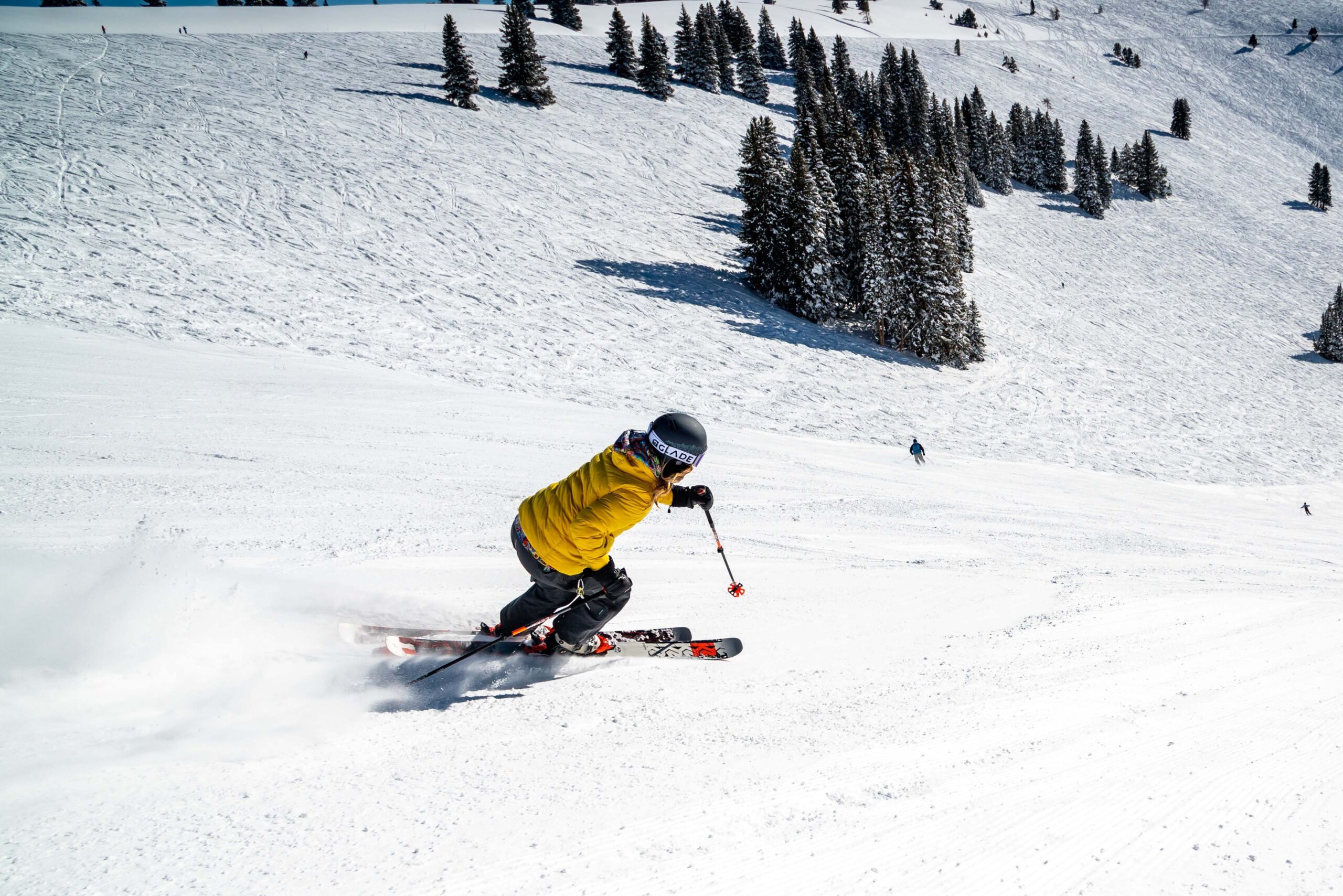
    With ski season just around the corner, it’s time to talk about the almighty ACL. I used to love to ski with abandon until I became a physical therapist and then skiing was never the same again! ACL sprains are common knee injuries and skiers are one of the most at-risk athletes. Others include soccer, basketball, and football players. That being said, I can no longer go downhill skiing without an arguably irrational fear of tearing or spraining my ACL. Sigh. 


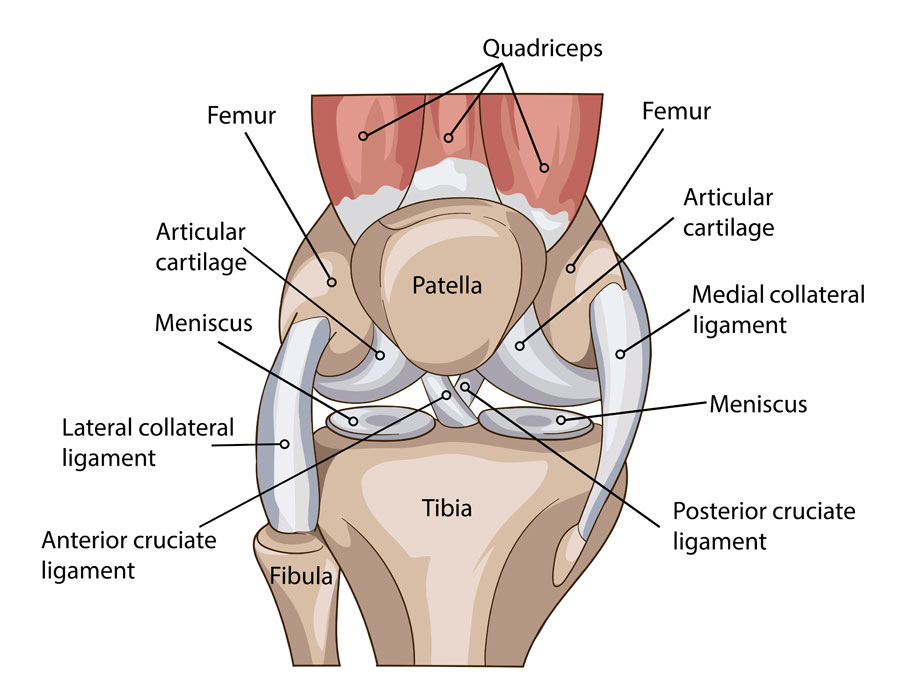
    The ACL, which stands for anterior cruciate ligament, is one of two cruciate ligaments that aid in stabilizing the knee joint. The ACL and PCL (posterior cruciate ligament) form an “X” or cross within the knee. The ACL comes from the posteromedial of the medial aspect of the lateral femoral condyle and inserts on the anteromedial tibia, blending with the medial meniscus. As it passes from the femur to the tibia, it spirals outward (laterally) on itself. 

    anatomy-of-the-knee


    The primary function of the ACL is to restrain the tibia (shin bone) from moving forward on the femur (thigh bone). It also restrains rotation and medial/lateral (varus or valgus) displacement of the tibia when the knee is straight. Finally, the mechanoreceptors present in all ligaments provide crucial proprioceptive information to the brain as to where the knee is in space at any given time.


    Roughly 70% of all ACL injuries are caused simply by doing the wrong movement. Furthermore, approximately 75% of all ACL ruptures are sustained with minimal or no contact. A common mechanism of injury involves a cut-and-plant movement, especially if there is rapid deceleration involved, which is why skiers are at-risk for injury. When turning, if there is a sudden change in direction of the knee but the foot stays firmly planted in the ski which is still pointing downhill, you’re replicating the cut-and-plant movement and can tear the ACL. Other mechanisms of injury include rapid stopping, landing awkwardly, pivoting, twisting, and direct blows to the leg.


    Studies have shown that females are at increased risk of ACL injury and have a 2.4-9.7 times higher incidence rate as compared to males. Some studies suggest that females have weaker hamstrings, so they mostly utilize the quadriceps while decelerating. This places increased stress on the ACL, as the quads are less effective at preventing forward movement of the tibia as compared to the hamstrings. A second factor that may increase the risk in females is a wider pelvis requiring the femur to have a greater angle towards the knee. One study using video analysis demonstrated that female athletes are more likely to bring the knees in when changing directions suddenly (creating a valgus stress), which increases the strain on the ACL. Finally, hormonal variations may increase the laxity of ligaments overall in females.


    When someone sustains an ACL tear, there may be an audible pop and the knee will often give out underneath them, which is often followed by an immediate onset of pain and significant swelling. Range of motion may be restricted, especially full extension. There may be widespread mild tenderness to touch as well. If not repaired, episodes of giving way are common, especially with pivoting and twisting motions. People are able to function without an ACL, but this often leads to an earlier onset of arthritic changes to the joint due to the decreased stability and increased wear and tear. 


    They say an ounce of prevention is worth a pound of cure, which has never been more true than with the ACL. An ideal ACL prevention program will incorporate plyometrics, neuromuscular training, muscle strengthening, and education on body mechanics and landing technique. Plyometrics should include high intensity agility drills that develop footwork and power, including cutting, jumping, and lateral movements. The athlete should be taught to begin and end movements with proper positioning involving hips and knees being sufficiently flexed, jumping and landing with knees over the foot avoiding a valgus stress, and landing softly. Strength training should be focused on the hamstrings and glutes. Any asymmetry in strength and movement patterns should also be addressed. Hmmm…does any of this sound familiar?? LYT Yoga® fits the bill and is the perfect preseason prevention training! However, if you find yourself struggling from an ACL sprain, click the link below to our YouTube channel for some simple exercises to help rehabilitate your knee following an injury. Until then, I’ll see you on the mat!


    Xoxo,

    Kristin