Tag: movement

  • 5 Simple Core Strengthening Exercises

    5 Simple Core Strengthening Exercises

    In the LYT Method, we stand by the motto “More Core” for a reason. Whether you’re reaching for something, balancing, getting up off the floor, or simply standing in one place, the muscles of the core are working to keep your spine and pelvis stable. Unfortunately, many people are weak in their core. Most people think only of the abdominals when they hear the term “core”, but there’s a much broader picture to consider when wanting to strengthen this area. We need to consider not only the spine, but also the girdles of the shoulders, hips, and pelvis when incorporating core strengthening exercises. 


    Why does core strength and stability matter and why incorporate core strengthening exercises? Movement of the body through space depends on the creation and transfer of forces between different segments of the body. For example when we bend over to pick something up off the floor, not only do we need the strength of the arms to lift the object up, but we need to stabilize and lift through the lower body and transfer force through the trunk just to make this movement occur. Failure to do so successfully can increase the risk of injury anywhere along this chain of movement. 


    Core stabilization exercises have been shown to reduce the risk of this type of injury, as well as decreasing pain, reducing disability, and restoring/increasing strength. When core muscles are activated, there is an increased stiffness of the spine which enhances stability, allowing for this transfer of force. We need to strengthen not only the deep postural muscles but also mover muscles, as both have been shown to be key in stability. 


    Here are five simple (yet challenging!) exercises to improve your core stability:


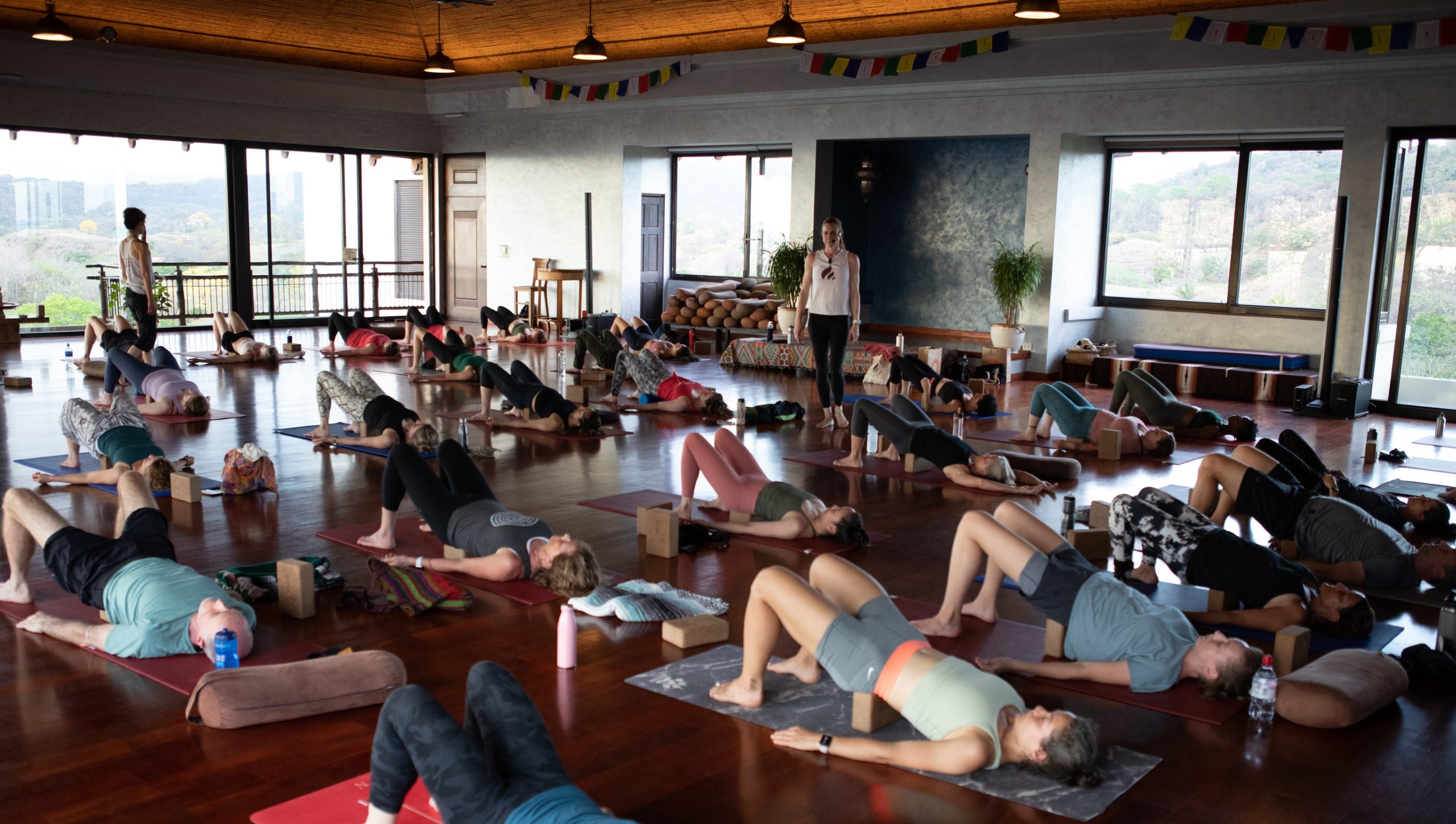
    1. Glute Bridge – as the largest muscle in the body, the glutes play a huge role in core stability, acting as both a mover and a stabilizer.
      •  Lie on your back with your knees bent and feet flat.
      •  Press down through the feet to lift the pelvis up off the floor, elongating in the spine (do not press up too high or the back will arch).
      •  Hold for 2-5 seconds, keeping the pelvis level. Lower down with control.
      •  Do 3 sets of 10-15 repetitions.
    2. Supine March – holding the spine stable while moving the lower extremities is Core Stabilization 101. 
      •  Lie on your back with your knees over the hips and shins parallel to the floor (feet off the ground).
      •  Keeping the knee bent, slowly lower the left leg to tap the toes to the floor. Do not let the back arch up or allow the ribs or pelvis to move. 
      •  Return the left knee over the hip and repeat with the right leg. That is considered 1 repetition.
      •  Do 3 sets of 10 repetitions.
    3. Side Bridge – this exercise targets the deep oblique abdominals as well as the stabilizing muscles of the shoulder and hip.
      •  Lie on your left side with your knees bent to 90-degree angles and your elbow underneath your shoulder.
      •  Lift your bottom hip off the ground, trying to keep your knees, hips, and upper body in one long line.
      •  Hold for 10 seconds. Try to work your way up to a 1-minute hold!
      •  Do 10 holds on each side. As you increase your hold time, decrease your repetitions.
    4. Forearm Plank – this is a 1-stop shop exercise, targeting all the layers of your abdominal wall, as well as the shoulders, upper back, thighs, and glutes.
      •  Start on your hands and knees and then lower the forearms to the ground with the elbows under the shoulders.
      •  Walk one foot back at a time, tucking the toes under and keeping the knees off the floor.
      •  Hold this position without letting the back arch or hips drop, while keeping the neck long and in line with the trunk.
      •  Hold for 10 seconds. Try to work your way up to a 1-minute hold!
      •  Do 3-5 repetitions. As you increase your hold time, decrease your repetitions.
    5. Half Kneeling Chop – another 1-stop shop exercise that combines core stability, balance and hip stability, and shoulder strength all together.
      •  Start on your hands and knees and then lift your hands off the floor coming into tall kneeling.
      •  Step the left foot forward so both knees are bent to 90-degrees. The left foot will be directly under the left knee and the right knee will be directly under the right hip.
      •  Option to hold a light weight in the hands or simply clasp the hands together.
      •  Rotate the torso towards the right leg, bringing the weight towards that hip, keeping the arms extended. This is the start position.
      •  Using your abdominals, rotate the trunk to lift weight diagonally across the body and above the left shoulder, keeping arms extended. 
      •  Reverse to the starting position. This is one repetition.
      •  Do 2-3 sets of 10 repetitions on each side.


    If you’re familiar with the LYT Method, all of these exercises should look familiar to you as we do these and variations of them in each and every class. More Core is not about getting six-pack abs, although that is an added benefit that many find comes with the territory. It’s about creating a readiness in the body to move well and prevent injury. It all starts with core stabilization, so give these a try! 


    Xoxo,
    Kristin

  • 717. Wednesday Q&A: Hip & Low Back Pain During Pregnancy, Cervical Spine Arthritis, & Misconceptions About Exercise & Movement Practices

    717. Wednesday Q&A: Hip & Low Back Pain During Pregnancy, Cervical Spine Arthritis, & Misconceptions About Exercise & Movement Practices


    Welcome to Wednesday Q&A, where you ask questions and we answer them!


    In this Wednesday Q&A, we answer your questions about hip and low back pain during pregnancy, cervical spine arthritis, and misconceptions about exercise and movement practices.


    Your questions:

    • Any suggestions for hip and low back pain during pregnancy? I’m in my 4th month and the pain gets worse from sitting for too long but also from working out. I’m keeping my exercise routine light and easy but the pain flares up, specifically on one side. Yoga, stretching, and even walking doesn’t feel as good as pre-pregnancy because I lost my body and movement awareness. Thanks!
    • A long-term yogi & friend (mid-60s) has recently been diagnosed with arthritis in her cervical spine, C2-C5. She has a fair bit of pain & is careful what she does in our LYT classes. In your opinion is there anything that I can do to help her?
    • What are some common misconceptions about exercise and movement practices?


    To learn more, and for the complete show notes, visit: lytyoga.com/blog/category/podcasts/


    Do you have a question?


    Sponsors:

  • Core CliffsNotes: Unveiling the Powerhouse of Your Body

    Core CliffsNotes: Unveiling the Powerhouse of Your Body

    When it comes to fitness and overall well-being, few elements are as crucial as understanding and harnessing the power of your core. Often misconstrued as just a set of abdominal muscles, the core is ultimately a complex network of muscles that provide stability, strength, and mobility to the entire body. From maintaining proper posture to excelling in athletic endeavors, the core plays a pivotal role in every movement we make. In our LYT classes, we often say the answer to joint aches, mobility concerns, low energy, and most everything else is MORE CORE. As the powerhouse of the body, the core transmits energy from the floor and lower limbs through the pelvis and spine, which aids in efficient movement and endurance. When the core muscles work collaboratively as a team, our movement and breath feel fluid and natural because all the systems in the body are operating well. The significance of the core’s role could be an entire book, but here are some CliffsNotes to highlight the core essentials and explore why optimizing posture is key to enhancing core dynamic stability.


    What is the core and why is it so important?

    The core encompasses more than just the visible six-pack abs that are often glorified in magazines or social media. The core container, as we often reference in LYT, includes the four layers of abdominals—the rectus, obliques, and the deeper corset-like muscle known as the transverse abdominis–along with muscles of the pelvic floor, spine, diaphragm, and shoulder girdle. An easy way to picture the entire core cylinder is to imagine all the muscles around and inside the pelvis, spine, ribcage, and scapulae. Together, these muscles form a stabilizing powerhouse that connects the upper and lower body, providing a solid foundation for movement. The core muscles are often synonymous with postural muscles in terms of function since they work continuously to support the skeletal structure in a variety of positions and planes of motion.


    Strengthening the core will give support to the musculoskeletal system to maintain more optimal posture, allowing you to better control your center of mass with movement. This dynamic control conserves energy, prevents injuries, and optimizes function. With movement and load (including gravity, body weight, or other weight) the core muscles provide the stabilizing anchor for the limbs to perform. Every daily activity, from bending down to tie your shoes to reaching for a high shelf, requires core engagement. A strong core ensures that movements are coordinated and efficient, reducing the risk of strain or injury. Whether you’re lifting a heavy object, running a marathon, or simply sitting at your desk, a strong and stable core (we also say “adaptable”) is essential for optimal movement, breath capacity, and joint health. Athletes across all disciplines rely on core strength to generate power, transfer energy, and maintain balance. Whether you’re sprinting on the track, swinging a pickleball racket, or practicing LYT, a solid core is essential for peak performance.


    Why do we emphasize TRIPLE S (aligning the skull, scapulae, and sacrum) to optimize posture and prime us for enhanced core activation? 


    When the skeletal scaffolding that represents our posture or carriage is out of alignment, the resulting sub-optimal posture creates an imbalance in the muscles and neuromuscular firing (lengthened muscles or underactive core muscles may be slow to respond and shortened muscles might continually activate instead). A slouched or slumped posture is common in our modern-day life, exemplified by rounded shoulders, forward neck, and a tilted pelvis. Optimal posture starts from the core and the collaborative engagement of the muscles leads to decreased pressure on joints or overreliance on individual muscle groups.  Weak core muscles can lead to poor alignment in any version of posture, which may contribute to musculoskeletal issues, depleted energy, and a delayed response between the brain and body. As the central channel of energy transmission and exchange, the core muscles are meant to respond appropriately to differing demands on the body. One of the most effective ways to enhance core stability is by optimizing posture. Proper posture aligns the spine, activates the core muscles, and promotes efficient movement patterns. When our posture improves, this nervous system communication is finer-tuned and adaptable, which translates into navigating through life with more reliable responses to stress and challenge.  


    Finally, how do we best improve overall core function? 


    I believe that practicing LYT is one of the best ways! LYT is designed with a specific method to prime the core muscle engagement and improve postural deficits through feedback and increased support for our center of mass in the RESET. We then apply this reinforced activation in the sequences through creative moves requiring more mobility, increased demand of bodyweight and gravitational forces, and with functional movements that mimic real-life activities, such as squatting, lunging, and twisting. Finally, we encode this information through repetition and added challenge in the STREAM to update brain mapping and nervous system communication. Each class is curated in this manner to provide greater carryover into daily life so that the core stability and postural alignment becomes more and more encoded/automatic. Both on and off the LYT mat, think of growing the spine and supporting with a balanced hug that summons all the core players to engage. An easy way to practice in daily life is to first set up your Triple S, where the skull, scapulae, and sacrum touch some part of a wall that you stand up against. Connect your brain to the feeling of having to sustain that alignment as you walk away from the wall and notice if you sense an energetic hold toward the center of your body. Continue to pay attention to your body’s alignment throughout the day, whether sitting, standing, or moving. Focus on keeping the entire spine lengthened and create a corset-like sensation around and within the pelvis to maintain a neutral position. As we say in LYT (and even have printed on our tanks!), STAND TALL, engage your core, and unleash the limitless potential within. This daily awareness to core and posture leads to true transformation. 


    I wrote this last year and feel that it speaks to the magic of LYT and the power of the core, providing an even more condensed CliffsNotes version:


    Movement is multifaceted and how we move is often determined by our habits. 

    • These habits become the GPS in our brain mapping, and we often need to update the software. 
    • Creating improved global movement often requires more specific or localized input. 
    • Building movement competency or literacy necessitates sensory-rich opportunities to develop and encode new motor planning and skills.
  • 720. Wednesday Q&A: Goddess Pose, Playground Movement, and Stress Relief

    720. Wednesday Q&A: Goddess Pose, Playground Movement, and Stress Relief


    In this Wednesday Q&A, we’re chatting about how to modify goddess pose for an anterior tilted pelvis, figuring out how you move differently to be fit and functional, and advising you on making movement work throughout the day. 


    Connect with Lara Heimann, The Redefining Movement Podcast, and LYT Daily:


    Today’s podcast sponsor:

    Herbal Face Food – Tighten your skin and reverse sun damage with this vegan and organic potion! Enter code LARA20 at checkout for 20% off.


    Follow the podcast:

  • Self-Care After An Injury

    Self-Care After An Injury

    When I started college, I had no idea what a physical therapist was or what they did. Sure I’d had some injuries in high school, but nothing that required rehabilitation. It wasn’t until I started having recurring injuries in college track and began seeing multiple athletic trainers and orthopedic doctors that I finally landed myself in a physical therapy clinic…and completely changed the trajectory of my life. I love being a physical therapist. I love that I can help heal peoples’ injuries and get them back on their feet the same way a PT many years ago did for me. But one of the things I love the most is knowing how to care for myself and not feeling helpless after an injury because I’m confident in the body’s ability to heal itself through self-administered therapeutic interventions and good movement. As a result, I have less fear of when pain happens in my own body. 


    Over the years, I’ve found that fear secondary to pain is one of the biggest limiting factors in one’s ability to recover after an injury. This fear can include wondering whether it will end, what is causing it, how much damage there is, and if movement will make it worse. These thoughts, beliefs, and expectations are important modulators of pain and can significantly affect one’s recovery from injury. While many people consider pain to be a physical response from the body, it is actually a response from the brain with both sensory and emotional components. When the brain processes a noxious stimulus from the body (sensory input) like a sprained ligament or torn muscle, how we experience that pain is shaped and influenced by previous experiences and how we react to them (emotional input). Anxiety, fear, and hyperfocusing on one’s symptoms can increase pain, while positive expectations and emotions can decrease pain. So one of the first things I tell my patients and myself after an injury is that it’s going to be okay. The body has an amazing ability to heal itself if we just put it in the proper environment to do so.


    Once we develop a more positive relationship with pain after an injury, we can consider it simply information from the brain. It’s our body’s way of telling us that something we’ve been doing isn’t working for this area of our body and we need to make a change. In many cases, that change does not include stopping everything altogether. Unless a bone is broken, I rarely recommend complete rest. Let pain or an injury be your opportunity to look closely at the way you move. Some simple strategies I use include the following:

    1. Observe how you’re moving, what might not be pulling its weight, and why this area is the victim of your mechanics. 
    2. Assess the range of motion and strength of the area that is injured and compare it to the other side. Do the same thing for joints that are nearby. For example, if you’ve hurt your knee, check out the knees but also look at the hips and ankles. If you’ve hurt your lower back, examine how your hips, pelvis, and ribs are moving. There’s a good chance that the injured area is overworking for an underperforming adjacent area. 
    3. Examine how you’re holding your entire skeleton (full body posture) throughout the day and if that may be impacting the injured area as well. Taking a holistic look at an injury is not only the best approach, but also helps the brain to tune into the body in a more objective manner (less emotion) and retrain suboptimal movement patterns to reduce the chance of further injury. 


    Once you’ve done your self-assessment, movement is the medicine. In essence, we want to stretch what’s tight, strengthen what’s weak, mobilize what’s stiff, and stabilize what’s hypermobile. If you find issues in areas away from the injured site that are underperforming, strengthen and/or mobilize them. Doing so will help you take demand off the injured area and the body will give a big sigh of relief. If you find deficits in the area of the injury, I don’t recommend a “no pain, no gain” mantra, but let pain be the guide. Working into significant pain or discomfort is likely to irritate an injury and prolong recovery. I give my patients/clients a simple analogy to follow which I call the “stoplight rule”. Green is no pain, yellow is mild to moderate discomfort, and red is significant or wincing-type pain. A nice mix of exercises that strengthen and mobilize in the green and yellow range seems to work best. Doing only green light exercises may not adequately restore full joint range and muscle function, which can prolong recovery and even create compensatory movement patterns. Exploring into those areas of yellow light movements and exercise not only works into fuller and more pre-injury ranges of motion, but also helps the brain to understand that the body is safe, allowing healing to occur quicker. Moderation is key and more is not better. Although working with a physical therapist or highly qualified movement specialist is often recommended with more severe injuries, don’t forget that the body is a great healer in and of itself. Try it out on your own and if that doesn’t work, seek the help of a qualified professional. 


    On the LYT Daily, we have TONS of short videos with drills and flows addressing a variety of injuries right at your fingertips. Many of the things in these classes are what we do to heal ourselves and they work! Overcoming fear is the first step. Education is paramount. Movement is medicine. Until then, I’ll see you on the mat!


    Xoxo,

    Kristin

  • 714. Monthly Motivation: Preventing Injuries through Movement

    714. Monthly Motivation: Preventing Injuries through Movement


    In this Monthly Motivation, Lara explains the importance of preventing injuries and shares techniques for injury prevention with a special focus on the role of the nervous system. You’ll learn common injuries, their causes, and ways to avoid or reduce them. 

    • How keeping the nervous system in shape helps in preventing injuries.
    • Ways to prevent injury by warming up, training, and resting your body properly.
    • Why a comprehensive approach can aid in long-term injury prevention.


    Connect with Lara Heimann, The Redefining Movement Podcast, and LYT Daily:


    Today’s podcast sponsor: 

    • Stop buying plant-based milk at the store, and make your own yumminess at home with Almond Cow. Check it out, and enter code LARA for a discount!


    Follow the podcast:

  • 713. Wednesday Q&A: The LYT Platform, Pelvic Pain, and Foot Pronation

    713. Wednesday Q&A: The LYT Platform, Pelvic Pain, and Foot Pronation


    In this Wednesday Q&A, we answer your questions about getting started in the LYT platform, dealing with hip and groin pain when physical therapy isn’t working, and how to train your body to relieve knee pain caused by foot pronation.


    Connect with Lara Heimann, The Redefining Movement Podcast, and LYT Daily:


    Today’s podcast sponsor:

    Herbal Face Food – Tighten your skin and reverse sun damage with this vegan and organic potion! Enter code LARA20 at checkout for 20% off.


    Follow the podcast:

  • Work Well Series Ep. 1: Enhancing Employee Well-being and Redefining Corporate Culture

    Work Well Series Ep. 1: Enhancing Employee Well-being and Redefining Corporate Culture


    In this introduction to the series, we touch on the world of corporate wellness, why it’s become such a buzzword, and why it’s time to redefine what it means to work well.

    Join our hosts, Lara Heimann and Kristin Williams, as they discuss the alarming statistics surrounding employee dissatisfaction and the negative impact it has on productivity, and employee’s personal well-being. They explore the concept of “working well” beyond physical fitness and delve into the need for holistic wellness practices in the corporate space. 

    With informative interviews from key players in the space, they will cover topics such as physical health, mental well-being, social dynamics, company culture, and prevention-focused health education. Discover how fostering a work environment that values employee health and happiness can lead to increased productivity, improved morale, and a thriving workforce. Get ready to redefine movement and learn how to create a company culture that promotes the well-being of both employees and employers.


    Connect with Lara Heimann, The Redefining Movement Podcast, and LYT Daily:


    Today’s podcast sponsor:

    • LYT Daily/Prime – Check out and sign up for LYT Daily and LYT Prime, including our 2-week and 1-week FREE trials, here: https://lytyoga.uscreen.io/ 


    Follow the podcast: