Category: Podcasts

  • 125 | Stop The Snowball Effect

    125 | Stop The Snowball Effect

    Today’s podcast is about the snowball effect. A snowball that rolls down a hill, gathering more and more snow can have a massive impact when it gets to the bottom, kind of like a runaway train. So what happens when we let our thoughts or suboptimal movement patterns snowball? In terms of our mental state, we get more and more overwhelmed. With movement, one thing compounds another and we can end up with a repetitive strain injury or movement dysfunction that’s difficult to correct. 

    I’ve developed an acronym to help you become aware of problems before they snowball. The acronym is STOP. 


    S stands for survey the situation. If you wake up in the middle of the night worrying about all the things you have to do, you can stop going down a path of negative thoughts by doing something simple like writing the things you have to do down. With movement it’s about focusing on how you move or stand so that you notice when you’re putting your body under any strain.


    T stands for tune into the feelings. The more we tune in, the more we’re going to be present in that moment to moment awareness. For example, how does it feel to hold your head up when it’s not in proper alignment?


    O stands for objectively respond. That means respond without personalizing it or without vilifying yourself. Instead of looking at yourself and saying, I slouch or, look at my poor posture, think, my head needs to be put back in this position. And then I’m going to hold it there.


    P stands for plan another route.So instead of going down the path with the snowball, work out what you can do when you start to feel overwhelmed or notice your posture or movement patterns are suboptimal. For example, when you wake up worried in the middle of the night, plan to have a drink of water, take 10 breaths then go back to sleep.


    Resources:

  • 124 | Repetitive Strain Injuries

    124 | Repetitive Strain Injuries

    Today’s podcast is about repetitive strain injuries, also known as RSI. What are repetitive strain injuries and what can we do about them? I’ll be focusing on two of the most common repetitive strain injuries – carpal tunnel syndrome and tendonitis.


    Repetitive strain injuries occur when you do repeatedly do something in an imbalanced way. This produces a stress that is beyond what your body can handle, then a strain occurs, and that strain leads to an injury. 


    Carpal tunnel syndrome occurs when you are flexing at the wrist for a great amount of the day. The kind of activities that cause us to flex at the wrist include holding a pen, holding your phone, driving your car, picking things up with your hand and typing at a computer. When we get swelling and inflammation in the wrist area, there is nowhere for it to go. So it presses and compresses on the tissue around the tendons and around the wrist joint and can also press on the vessels and nerves, causing pain, numbness and tingling. 


    Options to manage carpal tunnel syndrome include:

    • Sleeping with a splint at night to help keep the wrist neutral
    • Stretching out the wrist
    • Holding your wrists in a more neutral position as you work
    • Trying different keyboards
    • Improving your posture
    • Weight-bearing exercises like plank


    Tendonitis occurs when the Achilles tendon is shortened over and over again. This can happen when we’re wearing shoes with high heels, running with not-so-great posture or wearing shoes with too much cushioning.


    To manage tendonitis it’s imperative to look at where the imbalance is happening at its root, and that’s usually related to posture. It could be the way you are biomechanically moving. So when you take a step, if your outer hip is weak, it’ll cause your knee to drop and put more weight on the inside of your foot. So you have to strengthen your outer hips, your glutes and pretty much everything on the backside of the body. You also have to work on maintaining a neutral pelvis.


    Prevention is better than cure! Even if you haven’t had a repetitive strain injury, consider if you doing anything from a postural standpoint that could lead to a repetitive strain injury.


    Resources:

  • 123 | Shoulders | with John Frank, PT

    123 | Shoulders | with John Frank, PT


    In this episode, my brother, John Frank, joins me to discuss the shoulder complex. John is a physical therapist, athlete, and fellow lover of movement. So often, we think that the shoulder is simple, but the shoulder is, in fact, quite complicated! 


    When you see people, what are the main complaints people have in their shoulders?


    The complaint usually comes from the front and / or top of the shoulder, so your bicep or your rotator cuff. There is never a blanket diagnosis, because the shoulder is so intricate. When you have pain when reaching overhead, you have to look at the whole complex of the shoulder, not just one place. 


    What is a good exercise that would help people re-educate their range of shoulder motions between the different parts?


    Face a wall and put your arms overhead, and move the arms slightly out to the sides. Relax the arms completely, and pretend as though someone took their fingers on the lower part of your shoulder blade, moving it upwards. Be sure to keep your neck neutral in this position. 


    What do you see in the shoulder when people have a sloped shoulder? Is this something that can be helped? 


    Even though there are a lot of genetic features, a sloped shoulder is mostly acquired. The top of the shoulder blade and the bottom of the shoulder blade should be pointing straight down as vertical, parallel to the spine. People with sloped shoulders tend to have pain in their necks as well as tingling down the arm. 


    What can people with sloped shoulders, or conditions like that, do?


    Definitely do the wall exercise described above, but also look at your posture. Shrugging the shoulders, and even raising the arms above the head periodically can help as well. 


    Resources:

  • 122 | Seated Forward Folds

    122 | Seated Forward Folds

    Today’s episode is about why I don’t teach or practice seated forward folds. I’m not saying they’re bad, but there’s a lot of reasons I don’t do them. Primarily I want to make sure that people get the most bang for their buck out of any movement they do, and this is particularly important for people who don’t spend a lot of their day in movement. 


    Why do people practice seated forward folds?


    1. Traditionally, nearing the end of a yoga class, this movement can be seen as a way to calm the nervous system, as a way to prepare for savasana. 
    2. People want a deep stretch, and feel as though this move will stretch the areas they need. 
    3. I feel that sometimes yoga teachers do it as a filler because they run out of ideas.


    Why do I not teach or use this in my practice?


    When I stopped doing and teaching seated forward folds, I noticed more flexibility and mobility in myself and my students.


    In vinyasa classes you’re already doing a lot of forward folds in standing positions. So it’s so redundant to get on the floor and do more of them, we need a variety of movement. Also people who are sitting at desks most of the day already have half of the seated forward fold going, they don’t need to sit and do it more.


    I really want to encourage yoga teachers to think outside the box a little bit. We don’t have to do the same thing over and over just because it’s been done before. So think for yourself and test different things out.


    Resources:

  • 121 | Neutral Pelvis

    121 | Neutral Pelvis

    The position of the pelvis is fundamentally important for the alignment of the spine, all the way up into the skull. It forms the basis for our movement patterns and for our energy levels, and that’s why today’s episode is all about creating and maintaining a neutral pelvis. 


    What does “pelvis” mean? Where is the pelvis?


    In Latin, pelvis translates to “acetabulum” meaning, basin. 


    The pelvis is where your lower limbs come up and meet at the hip joint. The illium, the pubic bone, the sacrum, and the tailbone all meet to create the pelvis. The tailbone actually serves as an attachment point for the lower muscular system.


     What is a neutral pelvis? 


    The pelvis provides the foundation for the spine. When thinking about energy exchange and how we hold onto energy within the body, a neutral pelvis is fundamental for that. If you go against a wall and find your sacrum, pushing that against the wall will help you see where your pelvis aligns. If you find that it’s difficult, this probably means the front of your hip is tight and you have an anterior tilt. 


    Why is a neutral pelvis important?


    A neutral pelvis is important in supporting the spine, this way no excessive strain is placed on your spinal cord. It is also important for proper joint movement, and fundamental for taking big, deep breaths. 


    Helpful Acronym:


    • N: neck in line
    • E: elongate 
    • U: un-clench your jaw
    • T: tailbone down
    • R: ribs broaden
    • A: abdominals drawn together
    • L: line between the pubic bone and tailbone


    Resources:

  • 120 | What We Can Learn From Athletes | with Lara Heimann

    Today’s podcast is about what we can learn from professional athletes. Athletes are so fascinating to observe because of the discipline involved when working to be one of the best or the most elite in your sport. They can also teach us a lot about the power of drive and determination and inspire us to think about the potential of our own bodies. For instance, what would happen if we put a little bit more effort and energy into our own movement and aspirations of being more physically fit? Another thing we can learn from athletes is more of a what not to do. Many athletic endeavors are just too demanding to do long term, and there’s such a big difference from that high level of performance to being retired. Whatever we’re doing, we want it to be sustainable so that we don’t injure ourselves or experience burnout.


    Resources:

  • 119 | What Causes Stress | with Lara Heimann

    119 | What Causes Stress | with Lara Heimann


    Today’s podcast is all about stress. Whether it’s physical, mental or emotional, stress is not a bad thing per se. It helps us to be motivated and get things done. If we didn’t put any stress on our bodies or our minds, we wouldn’t grow stronger or improve. But it’s also easy to get too stressed, and sometimes that point of overwhelm can come on quite quickly. Too much stress can lead to injury, illness or fatigue. In this episode I cover how to manage stress so that it doesn’t become overwhelming or cause health problems. 


    In terms of physical goals, my tip is to be patient. We need to stress the body, but often we don’t need to do it as fast as we think we do. We’re sold this consumer nonsense that we can get a six-pack or whatever in five weeks. But whether you want to be able to go and run 10 miles or do a handstand, ramp up whatever you’re doing gradually and come from a place of patience. If you want to run a marathon for the first time, don’t rush, give yourself nine months and really plan out how you’re going to prepare for it. Yes, you could probably do it faster, but giving yourself extra time will allow you to run and recover well. People can also push themselves too hard with yoga. But yoga is a lifelong journey and there’s no point rushing to “accomplish” a fancy pose or something without taking the time to lay down all the building blocks.


    There’s many things we can’t control or predict in our lives. For example, if we suddenly lose our job or a loved one gets sick, we can get hit hard by mental or emotional stress. I think the best thing we can do is to prepare for these big stressors is to learn how to manage the smaller crises. When I start to feel stressed, I know that I have to put everything in focus and be very decisive about how I’m spending my energy and time. I think about how I can practice self-care and look after the things that are important to me, like my family. Then, once I’ve made some progress towards recovery, I start to think, what can I do to not come to this state of stress again? To avoid the kind of stress that overwhelms us, we should be very clear on the things that take energy away and even clearer about the things that fill us up.


    Resources:

  • 118 | Overactive Muscles | with Lara Heimann

    118 | Overactive Muscles | with Lara Heimann

    Today’s episode is what to do about over-developed or, as I like to think of them, over activated muscles. I get a lot of questions, particularly about the upper trapezius and the latissimus dorsi, otherwise known as the traps and the lats.  As always, share this with friends, especially anyone who has been complaining about neck or shoulder tightness.


    If the upper trapezius is over developed or overly activated, it’s often due to the weakness of the serratus anterior and the lower trapezius below it. More commonly I see that it’s because of the serratus.


    You can learn how to activate the serratus. One way to activate it is to stand facing a wall, a little bit away from it. Bring your arms up on the wall and place your hands on it or you can have your thumbs facing upward. Your arms are probably not straight out in front of you, but they’re up in a V. Then you can lightly slide the scapula up more, meaning the arm is going to slide up the wall, and you’re pressing a little bit into the wall as you’re doing this.

    Another way of working the serratus is to get yourself in a quadruped position where your wrists are under your shoulders and your knees are under your hips. Walk your hands forward a little bit so they’re not directly under your shoulders. And in that position, attempt to press the floor away like you were doing to the wall. 


    Shoulder shrugs can help you develop better and newer motor patterns and release some of that constricted tissue in the traps or the lats. There are two ways to do them. The first way I like to do in a low lunge but you can also do this if you’re sitting at your desk. You just lift one head of the humerus up, so the ball of the humerus, you just lift it  up, and then bring it back and then bring it down. So I would do my right side and then my left side, then repeat. As you’re doing it, feel the shoulder moving, but also get a sense of the scapula moving a little bit. This exercise is training that upper trapezius to not just grab and hold, but to kind of lift and release. 


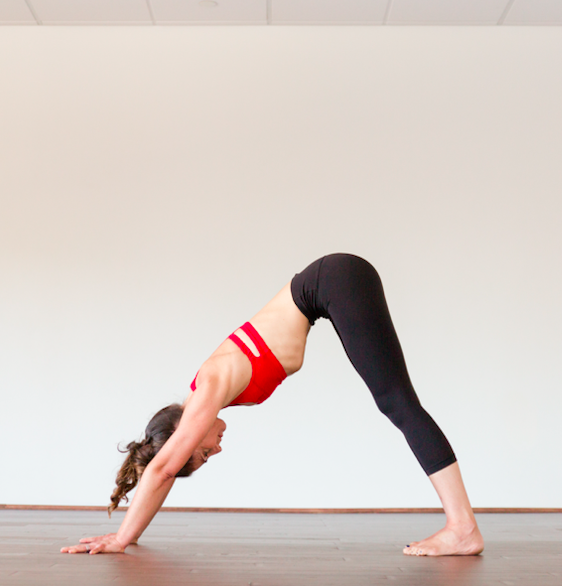
    The other way of doing some of that shrugging is in down dog. Think about pushing the floor away and shrugging the shoulder blades up by the ears, and then releasing down. Doing that over and over again will help you retrain some of these movement patterns.


    Resources: