Category: Blog Posts

  • PT Corner with Kristin Williams – Pain in the Butt

    If you’ve ever had Piriformis Syndrome, you know it can be a real pain in the butt…literally! The piriformis is a small muscle located in the buttock, just underneath the gluteus maximus. It’s one of six lateral rotators of the hip, but it is unique in that the sciatic nerve runs directly underneath it. The sciatic nerve is the largest nerve in your body, derived from the nerve roots from the lower back (L4-5) to the sacrum (S3). So while most other nerves in your body are as thick as spaghetti or linguine, your sciatic nerve is as thick as your pinky finger! So imagine this large rope-like structure coursing from the lower back and diving under the flat, pyramidal piriformis before heading south down the leg. In 10-20% of the population, the sciatic nerve actually pierces through the piriformis muscle, which is a quite unfortunate anomaly.


    So it’s not difficult to imagine how having issues with the piriformis muscle can affect the sciatic nerve. This is called Piriformis Syndrome and it’s a real pain in the butt. Symptoms can include pain and numbness or tingling in the gluteal region and possibly down the leg. While it is often caused by trauma, it doesn’t have to be sudden in nature. Prolonged sitting in hard chairs (Zooming all day long perhaps?) is believed to cause repetitive microtrauma to the muscle and/or spasms within the muscle belly, all which compress the sciatic nerve running underneath. It is also common in runners and cyclists due to the repetitive nature of those sports.


    Unfortunately, there’s no specific test to diagnose Piriformis Syndrome, so the diagnosis is made primarily based upon the symptoms. Patients present with localized tenderness to the muscle belly in most cases, as well as tightness and decreased soft tissue mobility. Traditionally, people respond very well to soft tissue massage, trigger point release, stretching, joint mobilization and strengthening of the hip and core when it comes to conservative treatment. Some of my favorite exercises include:


    • Figure 4 Stretch/Pigeon Pose – since the piriformis acts as an internal rotator of the hip above 90 degree of hip flexion, these two stretches into hip external rotation are key! If you’re sitting for a long time, you can cross the ankle on the thigh in sitting (like chair Figure 4) and hinge forward at your hips to keep the muscle from cramping.
    • Tennis Ball on the Wall – if your muscle is feeling tight, lean your hip against a tennis ball and the wall. Sustained pressure for 90 seconds can help release the muscle or a gentle rolling massage works well too. Just watch that you’re not compressing an irritated nerve and making things worse!
    • Hip External Rotation with a Band – tie an elastic band around your ankle and kneel on a swivel chair. Kick the heel towards the opposite leg, internally rotating the femur. Do this quick and against light pressure to really warm up the muscle. Follow up with Figure 4 or Pigeon Pose.
    • 90/90 Sciatic Nerve Glides – Lie on your back and grab behind your thigh so the knee is over the hip and bent to 90 degrees. Slowly straighten the knee, while keeping the hip flexed to 90 degrees. When you start to feel some tension in the buttock, rebend the knee. Perform 25-50 repetitions, never into pain. You’ll notice that you’ll be able to straighten the knee more along the way.


    In persistent cases, trigger point injection therapy is quite effective, especially in a muscle that is acutely inflamed or in spasm. And because this is a nerve impingement issue, finding ways to relieve tension on the nerve further up and down the chain (remember the birds on the wire?) is also very effective in treating symptoms.


    As they say, an ounce of prevention is worth a pound of cure. Restoring and maintaining optimal hip mobility and stability is key! Your LYT yoga practice is a wonderful place to start. We focus on the hips and a neutral pelvis as a way of minimizing stress on the body as a whole. So get on your mat, get your hips and glutes LYT up, and hopefully, you can avoid any literal pains in the butt for a long time!


    Xoxo,

    Kristin

  • Low Back Pain

    Low Back Pain

    If you’ve ever had low back pain, you are not alone. Low back pain (LBP) is one of the most common conditions I treat at the clinic and it affects people of all ages. Even school age kids have it, so it does not discriminate by age. It can be described as dull and aching or sharp and shooting. Sometimes LBP is accompanied by radiating pain into the back of the leg(s), buttocks, or anterior thigh. It can extend clear down to the foot in some cases. It’s no wonder that LBP is one of the most common reasons people see a doctor or miss work.


    There are many different causes of LBP. Congenital reasons such as scoliosis (curvature of the spine) and an increased or decreased lumbar lordosis (swayback or flat back). Injuries such as strains, slips, and falls, or car accidents. Degenerative changes in the spine are another common cause and include stenosis (narrowing of the spinal canals), degenerative disc disease (thinning of the intervertebral discs with age), and other types of arthritic conditions (ie, spondylosis and ankylosing spondylitis). Some conditions affect the nerve and cause entrapment either at the spinal cord or exiting spinal nerves, such as disc herniation/protrusion, spondylolisthesis, and sciatica.


    I actually prefer when a patient comes to me and hasn’t had any diagnostic testing. While knowledge is power, oftentimes in the case of LBP, ignorance is bliss. Studies have shown that we can pull 100 people off the street who have no back pain and ~70% of them will have degenerative discs/arthritis, ~50% will have a disc bulge or two, and ~30% will have a disc herniation…with no pain!!! People are shocked to learn this and wonder how can this be? So many different factors affect whether we have pain in the body. When it comes to low back pain and especially radiating pain such as sciatica or lumbar radiculopathy, this is especially true. And if you’ve been treated by me or have taken my Stretch class, you know I love the analogy of birds on a wire.


    I’ve always been fascinated by how birds sit on telephone wires. It makes me laugh to watch them shuffle from side to side, making room as new birds arrive and spacing out as others leave. Several years ago I began explaining neural tension to my patients and students as having “birds on a wire”. The more birds that sit on a wire, the lower it sags and the more tension. Tension on a wire (nerve) is a large reason for pain and discomfort. This is true not only for back and leg pain, but also for neck and arm pain. I consider anything a person has on an MRI as just another bird on the wire. Now some birds are bigger than others and may cause more tension (large herniation or bone spurs). Other birds aren’t going anywhere (stenosis, scoliosis, arthritic/degenerative changes). But just like those studies show, people can have birds of all sizes on their wires and not have any symptoms whatsoever. My job as a physical therapist is to get as many birds off the wire as I can and let the body do the rest of the work. It is an amazing self healer if given the opportunity.


    So what are some birds we can get off our wires? Tight hips and glutes. Your sciatic nerve runs right under your buttock muscles, so if those muscles are tight, they’re just birds pushing on that wire. Limited hip mobility. If you can’t move from your hips, where are you going to move? From your back. Poor body mechanics due to limited hip mobility…bird on the wire. Weak hips and core…bird on the wire. Hypermobility of the lumbar spine…bird. Hypomobility of the thoracic spine…peep peep! Prolonged sitting…cheep cheep! Poor posture…caw caw! Honestly the list goes on and I’m running out bird sounds. 🙂 Think about ways you may be putting too much tension on your wires. What are birds you can get rid off to free up the body to heal itself? LYT yoga is a great place to start because it’s smart yoga. Listen to the cues we give you and apply them to your daily life. Mobilize, strengthen, stabilize. On that note, I’ll see you on the mat!


    Xoxo,

    Kristin

  • Relaxation Breathing

    Relaxation Breathing

    Feeling stressed out? Anxious? Sleep-deprived? Yeah…me too. This has hands down been the craziest year of my life and I’m sure many people would agree with me. As much as I hate to admit it, sometimes we need more than yoga to relax. Deep breathing is one of the best ways to relax the body because when you breathe deeply, it sends a message to your brain to relax your body. Those things that happen when we’re stressed out, like increased heart rate, blood pressure, and respiratory rate, can all be decreased when you breathe deeply to relax. Here’s a quick physiology lesson to explain how it works:


    Your autonomic nervous system, which controls involuntary actions like heart rate and blood pressure, is split into two parts. The first part, your sympathetic nervous system, controls your fight-or-flight response. The second part, your parasympathetic nervous system, controls your rest and relaxation response. Both systems can NOT be working at the same time, which means if you activate one, the other will be suppressed. Deep breathing stimulates the parasympathetic nervous system and while it may be simple, it isn’t necessarily easy and takes practice. The more you practice, the better you’ll get at it There are many different ways to practice relaxation breathing, so play around to find one that feels the most natural to you. Most importantly, be kind to yourself as you practice and accept that you might not notice results immediately. Give yourself credit for trying and keep practicing, even just for a few minutes at a time, until you reach a point where you notice it’s starting to help. Here are a few different methods of relaxation breathing to try:


    Diaphragmatic Breathing

    • Sit or lie flat in a comfortable position.
    • Put one hand on your belly just below your ribs and the other hand on your chest.
    • Take a deep breath in through your nose, and let your belly push your hand out. Your chest should not move.
    • Breathe out through pursed lips as if you were whistling. Feel the hand on your belly go in, and use it to push all the air out.
    • Do this 3 to 10 times, taking your time with each breath.


    4-7-8 Breathing

    • This can also be performed sitting or lying down.
    • Put one hand on your belly just below your ribs and the other hand on your chest.
    • Take a deep, slow breath from your belly, and silently count to 4 as you breathe in.
    • Hold your breath, and silently count from 1 to 7.
    • Breathe out completely as you silently count from 1 to 8. Try to get all the air out of your lungs by the time you count to 8.
    • Repeat 3 to 7 times or until you feel calm.


    Roll Breathing

    • You can do this in any position, but while you’re learning, it’s best to lie on your back with your knees bent.
    • Put your left hand on your belly and your right hand on your chest.
    • Breathing in through the nose and out through the mouth, practice filling your lower lungs so your belly (left) hand goes up when you inhale through the nose and your chest (right) hand remains still. Do this 8 to 10 times.
    • When you have filled and emptied your lower lungs 8 to 10 times, add the second step to roll breathing: inhale first into your lower lungs as before, and then continue inhaling into your upper chest. As you do so, your right hand will rise and your left hand will fall a little.
    • As you exhale slowly through the mouth, make a quiet, whooshing sound as first your left hand and then your right-hand fall.
    • Practice breathing in and out this way for 3 to 5 minutes. Notice that the movement of your belly and chest rises and falls like rolling waves. Feel the tension leaving your body as you exhale and become more relaxed.


    So try one of these out and see if they work for you!


    Xoxo,

    Kristin

  • Scapular Stability

    Scapular Stability

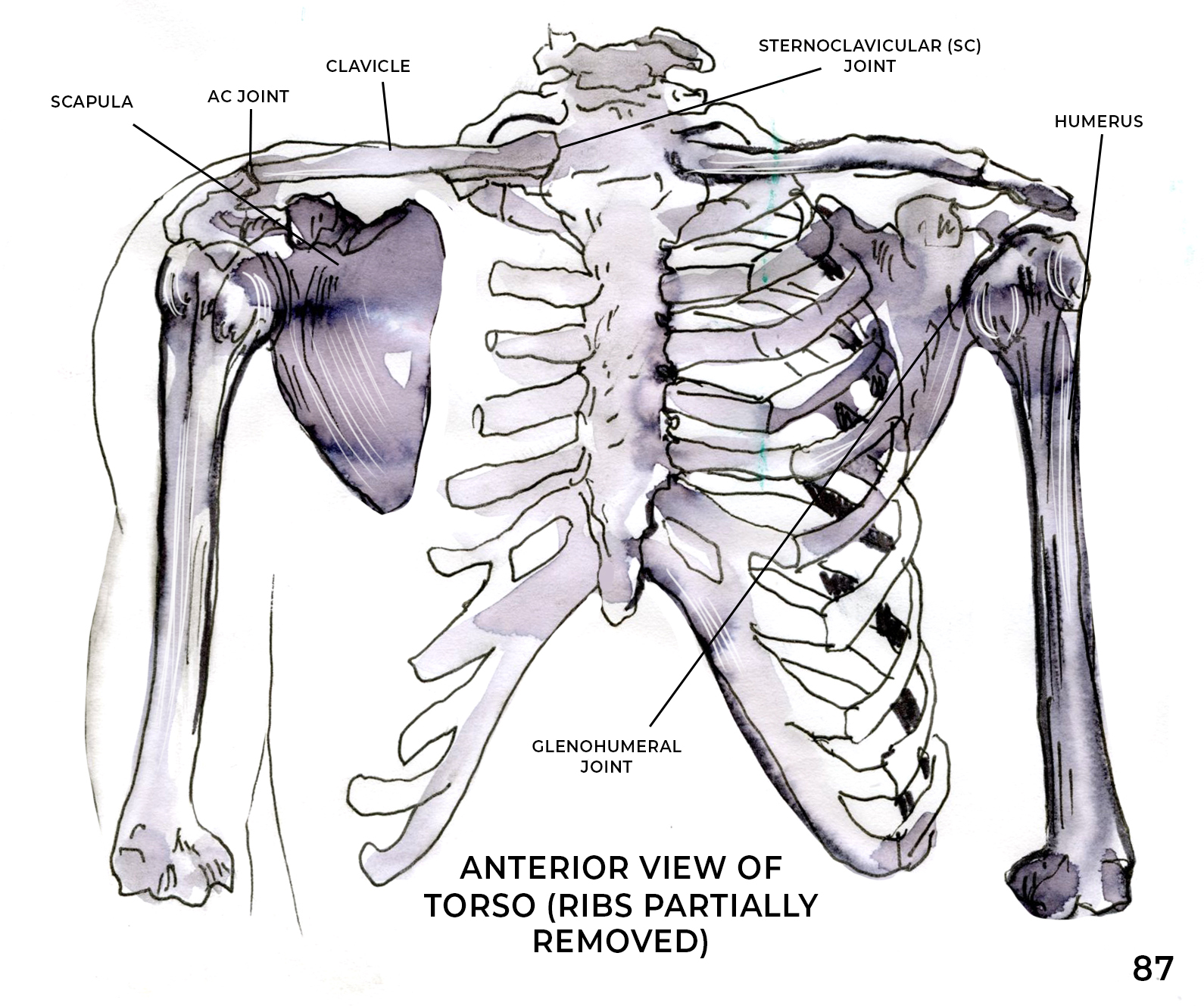
    When most people think of the shoulder joint, they usually only consider the space where the ball of the upper arm bone (humerus) articulates with the socket of the shoulder blade (scapula). In fact, most people don’t even know the socket is part of the scapula. Furthermore, calling the shoulder a “ball and socket” joint is a stretch, as it’s really more like a golf ball sitting on a tee. The socket is actually a small shallow disc (glenoid fossa). The ball (humeral head) is held in place passively by ligaments of the joint capsule and actively by the muscles of the rotator cuff. But the shoulder itself is really more of a “complex”, consisting of four separate joints that must work together to keep the shoulder complex functioning properly:


    1. Glenohumeral Joint – Humerus and Scapula
    2. Acromioclavicular Joint – Scapula and Clavicle (collar bone)
    3. Sternoclavicular Joint – Sternum (breast bone) and Clavicle
    4. Scapulothoracic Joint – Scapula and Rib Cage


    Unlike most joints of the body in which two bones are connected by ligaments and/or discs, the scapulothoracic joint relies purely on a coordinated dance of 17 muscles that attach to the scapula, as well as the mobility of the other three joints, to provide stability for the rest of the arm and shoulder. SEVENTEEN MUSCLES!!! Weakness in any one of the muscles attaching to the scapula, but particularly the large ones like the serratus anterior (Lara’s favorite!), latissimus dorsi, trapezius, and rhomboids, can affect how the shoulder and ultimately the entire upper extremity moves and functions. Poor movement patterns, muscular weakness, and limited joint mobility can lead to pain in and injury to the neck, shoulder, spine, elbow, wrist, and hand.


    Whether you are playing a racquet sport, doing yoga, or just trying to put away the dishes in an overhead cabinet, scapular strength and mobility are key to preventing injury. Weakness in these large “core” muscles can lead to overuse of the smaller muscles of the upper extremity and thereby cause injuries.


    The muscles of the scapula form force couples, which are muscular co-contractions that properly position the scapula for maximum shoulder function and provide a stable base of support for the entire upper extremity. It has been estimated that throughout 90% of shoulder range of motion, muscles (and not passive structures) are responsible for shoulder stability. Scapular issues are commonly seen in people with tight and overactive upper trapezius and pectoralis minor muscles, coupled with weak/underactive lower trapezius and serratus anterior muscles. This decreases the ability of these force couples to occur, resulting in decreased static and dynamic positioning (stability) of the scapula during movement.


    Corrective exercises can be very successful in restoring neuromuscular control of the scapula, helping to return to normal function and enhancing the overall function of the shoulder complex. An exercise program should include proximal kinetic chain exercises aimed at improving scapular muscle strength, flexibility exercises to minimize tight muscles pulling the scapula out of position, and exercises to enhance these functional force couples. In Lara’s podcast, Redefining Yoga, Episode 269 Wednesday Q & A, she describes some great ways to improve your scapular strength and stability. We will also be featuring some classes focused on the scapula in this week’s upcoming LYT® Daily, so be sure to check it out! One of the best places to begin to strengthen and stabilize the scapula is on your mat. I look forward to seeing you there!


    Xoxo,

    Kristin

  • PT Corner with Kristin Williams – Tennis Elbow

    With the desire to exercise outdoors on the rise, an increase in people playing tennis is to be expected, as people consider it to be rather COVID friendly: you can maintain social distancing guidelines and as long as both parties have clean hands, the only physical contact is hand-to-ball during serves. However, with increased time playing tennis comes an increased risk of developing tennis elbow, or lateral epicondylitis (LE). Lateral epicondylitis occurs when a person overuses the wrist extensors, which are located on the back of the forearm and attach to the outside of the elbow (lateral epicondyle of the humerus). The common extensor tendon, which attaches the muscles to the bone, gets inflamed and painful. Chronic overuse of the wrist extensors can cause the tendon to degenerate, at which point the diagnosis becomes lateral epicondylosis and is much harder to treat.


    Tennis is often implicated in LE because the muscles of the forearm act to stabilize the wrist when the elbow is extended, such as during a ground stroke. However, people can develop LE by doing a multitude of activities that require repetitive use of the wrist and fingers into extension, including typing on a keyboard, using a mouse, painting, cooking, and also with manual labor occupations, such as painters, plumbers, carpenters, and auto repair people.


    Symptoms of LE tend to come on gradually and include pain and tenderness in the lateral elbow and a loss of grip strength. Symptoms are worse during activity and ease with rest. Most cases of LE can be resolved with conservative treatment. If you find yourself suffering from LE, here are some home treatment strategies to try:


    • Rest – If you’re able to take a break from the repetitive activities, do so. If not, a tennis elbow strap can be used and acts to transfer the area of stress away from the tendon.
    • Wrist Stretching – With the palms facing down, flex at the wrist (opposite of what we do during the RESET at the beginning of class), bringing the palm side of the hand closer to the forearm. You can use the opposite hand to provide a gentle overpressure. Do this with the elbow bent and straight, holding for 60 seconds. Pronating the forearm and internally rotating the shoulder deepens this stretch.
    • Light Eccentric Strengthening – Holding a 1-2 lb weight (a can of soup works too!) and sit at a table with your forearm supported and hand hanging off the edge. Use the opposite hand to assist the wrist into extension, remove the assistance and hold for 5 seconds, and then SLOWLY lower the weight, bringing the wrist back into flexion (hand hanging below the level of the table). Do 3 sets of 10. Increase the weight resistance as tolerated.
    • Soft Tissue Mobilization – Perform gentle massage along the muscles of the forearm, encouraging muscle length and release of the fascia. A light cross-friction massage of the tendon where it attaches to the elbow can help increase blood flow and healing to the area, but don’t overdo it!
    • Neck and Chest Stretching – a lot of times pain in the elbow is directly related to what’s happening further up the chain. So stretching the muscles of the neck (upper trapezius, levator scapula, and scalenes) and chest (pectorals) can greatly decrease LE symptoms. Good posture is key as well!


    Finally, if the injury is sports-related, you may want to have a professional (physical therapist or sports professional) take a close look at your technique and equipment. Having the proper gear and most energy efficient technique will greatly decrease the demand on the elbow. Having adequate strength in the shoulder girdle and core is also hugely important for treatment and prevention of LE, so stay strong with your regular LYT™ yoga practice and I’ll see you on the mat! 🙂


    Xoxo,

    Kristin

  • Tension Headaches

    Tension Headaches

    Tension headaches are the most common type of headache. Traditionally, they manifest as pain that comes over your head like a hood or around your head like a headband and can occur on one side or both. Any activity that requires the head and neck to be held in the same position for prolonged periods can result in a tension headache. Considering that many of us are spending a lot of time on computers, laptops, and our phones these days, it’s no wonder they are the most common type! Other activities such as physical and emotional stress, anxiety, eye strain, fatigue, caffeine (too much or too little), clenching the jaw, and migraines can also bring them on. Tension headaches occur when muscles in the head and/or neck contract or go into spasms called trigger points. Trigger points send pain in a very specific pattern (such as the hood or headband) and can be reproduced with pressure at specific points in the muscle belly. The good news is that tension headaches and trigger points respond very well to treatment and can be managed independently! Here are some tips to treat and prevent tension headaches:


    • Tape two tennis balls together or put them in a sock and tie a knot to keep them side-by-side. Lie down with the tips of the tennis balls right under the base of the skull. You can maintain static pressure or nod the head up and down and side-to-side for a massage of the tense muscles (called your suboccipitals). This is especially useful if you find yourself in the middle of a tension headache. It may be uncomfortable at first, but eventually, the muscles will relax and you’ll find relief.
    • If you work at a computer all day, set a timer on your phone to go off every 30-60 minutes. Take a few minutes and do the following each time the timer goes off:
      • Perform 10 Chin Tucks – sit up tall and draw the ears back in line with the shoulders. Hold 5 seconds each.
      • Lean your head to one side, hold 20-30 seconds, and then the other side.
      • Interlace your hands behind your head, draw your chin down to your chest, and gently press straight back into your hands until you feel a stretch at the base of the skull. Hold 10 seconds. Turn your head 30 degrees (looking towards one armpit) and press gently back into the hand on that side. Hold 10 seconds. Repeat to the other side.
      • Keeping the hands behind the head, arch back over the top of the chair, allowing the thoracic spine to extend and the chest to open. You can hold for 10-15 seconds or rock slowly back and forth, flexing and extending the upper back.


    They say an ounce of prevention is worth a pound of cure, so the best way to keep tension headaches at bay is by maintaining good posture throughout the day and managing your stress with your regular LYT yoga practice! Tadasana, or Mountain Pose, sets the head, shoulders, hips and ankles in perfect alignment, allowing those suboccipital muscles to lengthen out, and takes strain off the muscles of the neck by eliminating their need to hold the head up. So find Tadasana to eliminate Tension!


    Xoxo,

    Kristin

  • Knee Pain with Running

    Knee Pain with Running

    With spring finally here, it’s time to talk about common injuries sustained with increased outdoor activities! Especially if you’ve been cooped up in the house over the winter and have the itch to hit the road running. Overuse injuries of the knees such as patellofemoral syndrome are common in the spring and early summer. Some key ways to avoid anterior knee pain associated with patellofemoral syndrome (also known as chondromalacia) include:


    1. Make sure your shoes aren’t past their expiration date! A good rule of thumb is to replace your running shoes every 500 miles. If you aren’t a regular runner and they’ve just been sitting in the closet for years, it’s probably time for a new pair sooner than that due to structural breakdown of the shoes themselves.
    2. Avoid running on the edges of the road where the pavement is crowned. Whenever possible (and only if there’s no traffic), run in the middle of the road or change sides regularly. This makes early mornings the best time to run when the traffic is the lightest.
    3. Softer surfaces are your best option, so choose the towpath over the road and the road over the sidewalk. The softer the surface, the less the force through the joints.
    4. Warm up before you hit the road. A few rounds of Sun Salutation 1 (what we begin every class with) is a great way to get limbered up, followed by a short walk. Taking the time for some static stretching at the completion of your run is a good idea too (like those in Stretch class).
    5. Build up your mileage slowly. No more than 10% increase per week is a good rule to follow. Start with just a mile or two and gradually increase. Doing a walk-run combo is a surefire way to keep injuries to a minimum, especially if you’re new to running.


    Happy knees, happy running!


    Xoxo,

    Kristin

  • 6 exercises that are a part of Yoga HIIT with Lara Heimann

    Infusing your yoga practice with high intensity interval training is a great way to create a complete movement experience. HIIT drills elevate your heart rate, challenge your muscular strength and endurance, and leave you with more of an endorphin high. I have been implementing HIIT exercises for over a decade and their inclusion signified a big shift in my yoga practice.


    Here are six examples of HIIT exercises that you can bring into your yoga practice. Aim to repeat each one 30-60 seconds.


    1. PLANK RUNS: from plank, bring one knee toward the belly at a time and then pick up the pace alternating right and left knees.
    2. PLANK JACKS: from plank, move both legs out to the side, like a jumping jack, and return feet to starting position. Continue moving legs out and in with a quicker pace.
    3. SQUAT HOPS: from goddess pose (wide-legged squat), reach for the ground and then swing arms up as you hop off floor. Return feet to ground and repeat reaching down with arms and hopping up.
    4. BURPEES: take your vinyasa sun salutation up a level by hopping back to plank and then hopping back to front of mat and hop up to upright. Repeat this burpee move at a manageable pace.
    5. DOWN DOG HOPS: from Down dog, bend knees and push off the floor in a hop. Catch air and land with bent-knees into down dog and then repeat the push off.
    6. SIDE PLANK variation: in side plank with the left hand on floor under left shoulder, bring right arm over ear and then pull right elbow to right knee and straighten both elbow and knee to the starting position. Repeat this action and then switch sides.