Category: Friday with Friends

  • 113 | Connect To Your Core | with Lara Heimann

    113 | Connect To Your Core | with Lara Heimann

    Today’s episode is all about connecting to your core without doing abs. In other words, the traditional kind of sit-ups or anything that involves getting on the floor. I really love doing those at the beginning of class because there’s something about awakening these muscles before you ask them to do the job that they’re supposed to do, which is primarily to hold your center steady and strong so that you can move your limbs with ease. The exercises I recommend in this episode will enable you to work your deeper abdominal muscles.


    How to connect to your core without doing floor work

    Go against a wall and put yourself against the wall so that your back is on the wall and you’re facing into the room, then bend the knees and walk your feet a little bit away. Press back into the wall with the back of your ribs and then draw that whole circular area around the navel, draw it together first and then back towards the wall. And if you find that to be challenging, take your hands and do that action with your hands so your fingers will pull in toward the navel, and then pull back. So you’re almost acting as your own corset with your hands. I would say do that many times a day to start that action of using the core without having to get down on the ground.

    Then the idea is to take that feeling and incorporate it in your daily life. So come away from the wall and start to bend your knees. But then immediately hinge at your hips so you’re doing a squat. Come down so that your hips are still higher than your knees, but your torso starts to fold over like it would sit on your thighs. So it’s really keeping everything symmetric. Your hips go back, your knees bend, and then keeping the chin neutral, stay at a place where your belly isn’t on your thigh. Then do the same action you did on the wall, pull everything together from that solar plexus, from that circle, and then pull it into the back and hold there.


    So now you’re utilizing the core, you’re working the abs without being on the ground by stabilizing your spine as it starts to flex. You’re flexing at the hips, but the trunk is moving from a vertical position. So more gravitational forces are going to be pressing down on the spine. So your reaction is to pull up in the abdominals. The next stage from there is to stay tilted like that but slide your right leg back beyond the right toes. So if you have shoes, take the shoes off if possible. So you’re now from that squat position where you’ve tipped, you’ve tilted forward, your hips are back, you’ve held your belly in there, and I would say try and hold it for a minute and work your squats up to two minutes, three minutes. Then you slide that right leg back. 


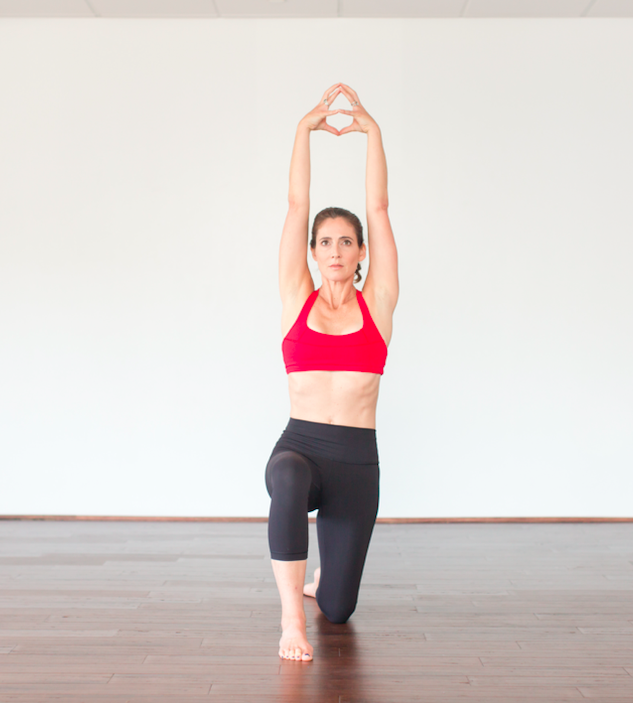
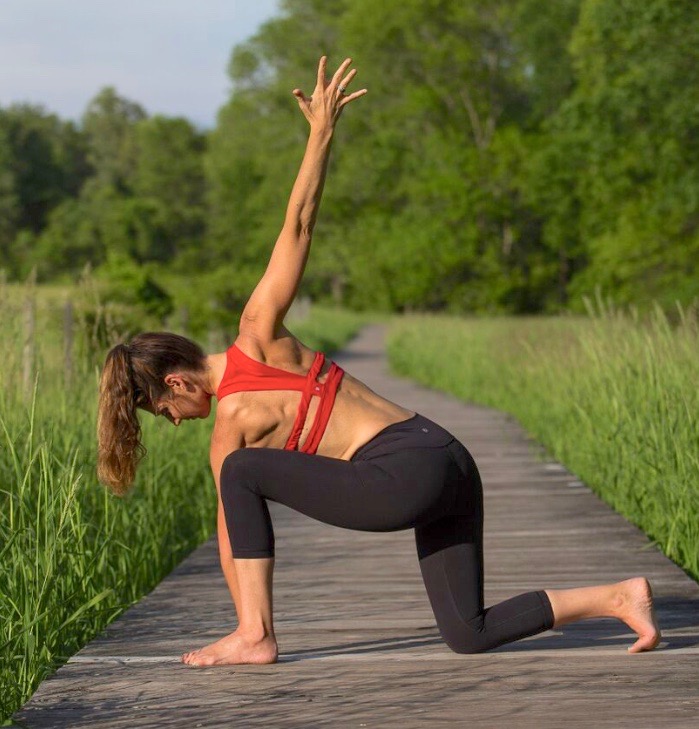
    So you’re in this crescent lunge, but a tilted crescent hill lunge. So your right leg is back, your left leg is forward and the abdominals are in. And then stay pulled in from the solar plexus, pull the belly into the back and bring your hands at kind of the tops of your pelvis. So right where the jeans would sit, put the hands there and cinch the sides in as well. So you’re working the abdominals all the way down there. Then you could bring just your right arm forward by your right ear. And then bring your left arm back. So now you’re in this tilted crescent lunge where your right leg’s behind you, your left leg’s in front, your right leg is straight, you’re on your right toes. The right arm is by your ear. We’re working the abdominals because you’ve got gravity happening. You’re now moving your arms as well as trying to stabilize the grounding action of your legs.

    And then you repeat all of that on the other side. So the right leg would be forward and the left foot back. 


    And for somebody who is someone’s grandmother, for example, I would give them an exercise like this but I would just have them hold on to the wall or a chair for the balance in that tilted crescent lunge. But no one is ever too old or too disabled in their movement patterns to start working more from their core.


    Help break a world record

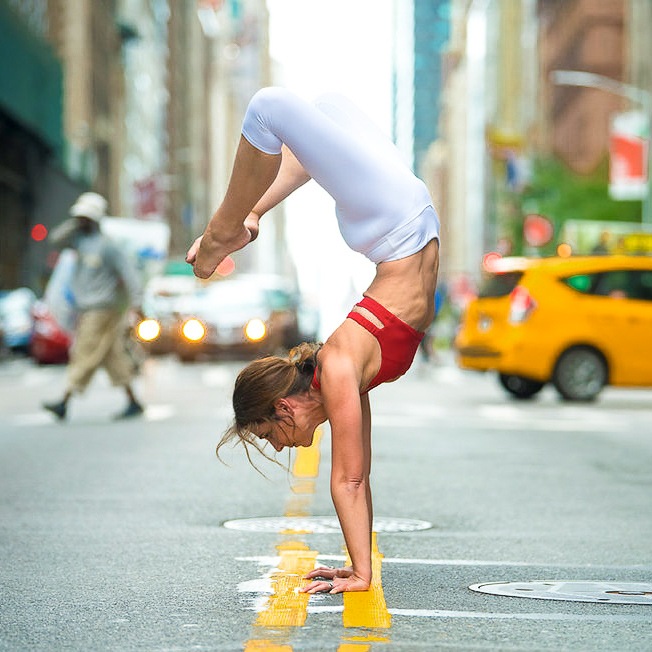
    Come and join me on August 3 in New York City to break a world record for the most amount of handstands done simultaneously! Right now the current record is 399 and I want to smash that. You don’t need to know how to do a handstand. I’m going to take an hour and take you through a class that will give you the building blocks of how to get on your hands and get a little air time. We just need you to get off the ground briefly. 


    Resources:

  • 112 | What To Do About Knee Pain | with Lara Heimann

    112 | What To Do About Knee Pain | with Lara Heimann

    Today’s podcast is all about knee pain. I have so many people ask me on a regular basis what they can do about the pain that they are experiencing in the knee or knees, and the knee is one of the most common body parts to get injured. The types of knee pain that people experience are due to a variety of causes and a lot of it is to do with the anatomy of the knee itself. The most common thing that I deal with is overuse injuries, but so much of this can be avoided or can be remedied when you work on your overall mechanics of the body, and that starts with how you stand.

    Things to look at if you are experiencing knee pain include:

    • How are your hip and your ankle moving? 
    • What is your running technique like? 
    • Are your glutes weak? 
    • Can you stand on one leg easily and not let that hip slide out to the side or do you kind of lock out at the knee?
    • Is your core weak?
    • Are you are you doing a variety of movement? 
    • Are you overly training one particular way? 
    • Did you increase whatever you were doing really, really quickly?


    Resources:

  • 108 | Supporting and taking care of the sacred sacrum | with Lara Heimann

    108 | Supporting and taking care of the sacred sacrum | with Lara Heimann

    Today I talk about the sacrum, one of the most essential parts of the human anatomy. The sacrum is a triangular structure located at the base of our spine which acts as the bridge between our spine and our pelvis. 


    The bulk of the sacrum lies between the two sides of the pelvis. Energy from below is transferred back up the spine through the sacrum and vice versa. Clearly, the sacrum is vital, if we didn’t have one, we wouldn’t be able to do anywhere near as much movement as we do.


    So important is the sacrum that its name means sacred in Latin. The Ancient Greeks and Romans both recognized its importance.


    Proper balance is the key to a happy and healthy sacrum as it is the center for support of the body. The muscles around the sacrum need to be well balanced to carry out this job. Get the glute muscles firing including pelvic floor muscles. Boost the muscles to the front and back of the sacrum so it isn’t being pulled on.


    The coiled energy contained in the sacral area has the potential to extend further energy throughout the entire nervous system.


    Resources:

  • 105 | Trip Planning and Dealing With The Unexpected | with Mark Heimann

    105 | Trip Planning and Dealing With The Unexpected | with Mark Heimann

    This episode I chat with husband Mark about the planning of hikes and trails including which matters need to be taken into account before you set out. We also talk about our original inspiration behind hiking and how to deal with unexpected events.  


    We also chat about the following:


    • Doing the research before hiking.
    • Factoring in time frames for the hikes.
    • Including children’s needs on the trip.
    • The drawbacks of going through tour companies.
    • With vegan needs, it’s often much better (and more cost effective) to do the arranging yourself.
    • The importance of booking well in advance.
    • Planning for rainy days.
    • Getting the lightest shoes that you still find comfortable.
    • The importance of using hiking poles. Great for balance and working your core.


    We also talk about why we choose to go on trails in the UK and go into detail about the natural advantages of walking through this country. Keeping an extensive blog of each is also highly recommended, something that becomes an invaluable resource for both you and other hikers. 


    Needs of children are so vital. We talk about the needs of our daughter Olivia on the hike in the middle of Wales. Her stomach virus meant we needed to create a plan B. As parents we could see she was struggling and so made the contingency plan to fly her home with our friends.


    Resources:

  • 103 | Working on the energy in your posture | with Lara Heimann

    103 | Working on the energy in your posture | with Lara Heimann

    Today’s podcast is about posture, something I talk about all the time. You immediately have an opinion of someone you see based on their posture. Are they slouched for example? It is from a person’s posture that we receive subliminal messages. We “sense” their energy.


    Slouching is a very closed down position. There is negative energy associated with this position, something we get from the person even if we’re not intellectually aware of the exchange. On the other hand, an aggressive “fight or flight” posture means you stay in a sympathetic nervous system response, which is very stressful.


    It’s important to find a posture that feels balanced, that feels optimal and grounded.]


    • The skull, the shoulder bone and the base of the spine are critical in working out the optimal alignment.
    • Find a more upright spine by leaning up against a wall, or lying on the floor.
    • Notice the area that is not connecting properly to the wall or floor.
    • If one of the three areas feels like it’s pulling away, that’s the area that may be restricted.
    • Work on the head, work on your pelvis.
    • When you find your optimal pose, it will not only help physically but also in your day-to-day energy exchange.
    • Take a picture of yourself to gauge your pose, not judging but looking at how to become more upright, more energetic.


    Learning to see the energy in your own body will allow you to see the energy in others. Correcting our own posture will help boost our own energy and make us better human beings.


    Resources:

  • 102 | Selecting The Right Yoga Teacher Training | with Lara Heimann

    102 | Selecting The Right Yoga Teacher Training | with Lara Heimann

    More and more people are entering yoga teacher training each and every year. Sometimes people enter these classes, not so much to train as a teacher, but to deepen their knowledge of yoga. However, what you often don’t know when you sign up for classes is what you’re going to get for your money.


    As well as the logistics of attending these intensive training sessions, there are a number of other things you should research.


    These include:

    • Do you like the teacher’s philosophy?
    • Does the teacher have a good understanding of the body?
    • Do they understand the body in movement?
    • Are they teaching you to teach yoga?


    I use the example of my cousin to demonstrate this. She wanted to do yoga teacher training and signed up with a famous school. However, she found that it was not really relevant to her. She wanted to learn about the body, learn how to teach people. She learned from her initial response and eventually found what she was looking for. The point I make is that you need to make sure the teachers are top quality and understand exactly what you want to learn.


    1. Make sure the teacher or school, offers exactly the type of yoga training you want to learn.
    2. If logistics are impossible, check out online courses.
    3. Immersive courses work well. 
    4. Being in a destination and learning in person is wonderful.
    5. Understand the style and the teachers of the school.
    6. Are they teaching you how to teach yoga?


    Hone in on the type of yoga you want to teach, the type of teacher that you want to learn from and make that the Number One thing. Have the patience, the perseverance and the clarity to go for what you want.


    Resources:

  • 100 | 100th episode with International Yoga Day! | with Lara Heimann

    100 | 100th episode with International Yoga Day! | with Lara Heimann

    This episode, I am celebrating the one-hundredth show of Movement By Lara, which also coincides with International Yoga Day. You’ll find out what yoga means to me and how I see yoga in relation to everyday life.


    I believe that we need to pay attention to alignment through yoga and then carry that into the rest of our day. Yoga is an extraordinary help here. Its beginnings date back to around 5,000 years ago and there has always been an underlying basis to the yoga, which is showing how you can be a better human in the world. It’s interesting to note that yoga wasn’t always accessible to everyone. In its early forms, it was often restricted to privileged castes and was usually practised by males.


    However, now anyone can learn yoga. You can learn on your own at home or you can learn it from a teacher in a group setting. Whatever you’re doing to making yourself a better human.


    The Bhagavad Gita teaches us that we need to do actions that do good in the world. All actions have consequences (karma). We learn to act for, not just our good but also for a greater good. Are we able to offer something bigger for the benefit of the world? Yoga can help us connect and changing things. We investigate what we can do to raise consciousness.


    Happy International Yoga Day!


    Resources:

  • 099 | Lara talks to special guest: her 14-year-old son Jonah | with Jonah Heimann

    099 | Lara talks to special guest: her 14-year-old son Jonah | with Jonah Heimann

    In this episode, I chat with my fourteen-year-old son Jonah about his hiking experiences, what he gets out of the treks and what he sees as the challenges. His answers, particularly on how he overcomes the challenges, are both interesting and educational.


    Jonah explains how hiking gives him a break from the classroom and electronics and a chance to spend quality time with the family. He talks eloquently of the challenges of a long hike, particularly if there’s inclement weather. As Jonah says, the walking isn’t the tough part but add in wind and rain and it becomes interesting!


    As I say, sometimes this mental and physical struggle, is a metaphor for life. We need to struggle sometimes. As Jonah says, his experience, not just in hiking but also in situations like playing basketball is to tell himself that he can do it, to change his mental perception.]


    As I say to him, our lesson to him is to never let yourself get down. Jonah talks about the importance of this lesson and how, as a young man, he understands that pushing through barriers is hard but necessary. Jonah’s point about helping to raise money and awareness for charities is one that resonates.


    Resources: