Tag: pain

  • Golfer’s Elbow

    Golfer’s Elbow

    Golfer’s Elbow


    The weather is getting nice and people are already hitting the green and getting back into the swing of things, literally.


    One injury we see in golfers is called medial epicondylitis, or golfer’s elbow.


    In athletics, it is also seen in throwers, rock climbers, bowlers, and weightlifters. Golfer’s Elbow (GE) is primarily caused by repetitive eccentric loading of the wrist flexors and/or forearm pronators, coupled with valgus overload at the elbow. A valgus force is one where the lower arm moves away from the body while the upper arm stays in close (so imagine “knock knees”, but in the arms).


    With golf, the intense valgus force at the elbow occurs during the late phase of the golf swing just before and during contact with the ball. This same valgus force occurs during the late cocking phase of throwing, which is why this is also called thrower’s elbow. Simultaneous wrist flexion and/or forearm pronation during ball release may produce even greater stress on the tendon, which is why technique matters. Medial epicondylitis is also seen in the general population in careers requiring repetitive upper extremity use, such as carpenters, massage therapists, utility workers, and butchers.


    Golfer’s elbow is a chronic tendinosis of the flexor-pronator muscle group, right where it inserts on the medial epicondyle of the humerus. The flexor-pronator muscle group is composed of the pronator teres (which pronates or turns the forearm down) and common flexors of the wrist and hand, including flexor carpi radialis, flexor carpi ulnaris, flexor digitorum superficialis, and palmaris longus. With GE, the tendons of the flexor carpi radialis and pronator teres are the most commonly involved. The inside ligament of the elbow, called the ulnar collateral ligament (UCL), also attaches to the medial epicondyle. Together, the UCL and the common flexor tendon provide stability against flexion and valgus forces at the elbow.


    Just like lateral epicondylitis or tennis elbow, medial epicondylitis or GE is considered a chronic tendinosis as opposed to an acutely inflamed tendinitis. There are four proposed stages of epicondylar tendinosis:

    1. Generalized inflammation – friction causing inflammation of tendon
    2. Angiofibroblastic degeneration – weakening of the tendon
    3. Structural failure – microtearing of tendon
    4. Fibrosis/calcification – failed reparation process which yields scar tissue


    People with GE usually present with pain at the medial aspect or inside of the elbow. It is worse with activities, especially gripping, flexing the wrist, pronating the forearm, and throwing. Pain usually comes on gradually, but can be sudden if caused by trauma. Occasionally the pain radiates into the forearm and wrist. Some people may complain of associated numbness in the lateral wrist and last two fingers secondary to impingement of the ulnar nerve at the elbow. Often, there is tenderness to touch roughly 0.5-1 cm below or distal to the medial epicondyle. Symptoms are normally relieved by rest. Pain is aggravated by resisted wrist flexion and pronation.


    Treatment of Golfer’s Elbow begins with rest. People should refrain from activities that exacerbate the symptoms, particularly repetitive wrist flexion, forearm pronation, and valgus stress at the elbow.


    Kinesiotape is useful to limit the maximum contractile force generated by the flexor-pronator muscle group. Once acute symptoms are alleviated, the focus turns to stretching and strengthening. Each phase of rehab requires targeted exercises with increasing repetition and speed. Initially, motion of the wrist and elbow is emphasized with non-weight bearing exercises and self-directed stretching. Once pain-free range of motion is achieved, tendon rebuilding and strengthening begins. Concentric open and closed chain exercises are used, increasing in weight and repetitions as tolerated. Finally, eccentric strengthening is implemented.


    A popular exercise that has been shown to treat chronic GE is the Reverse Tyler Twist. A rubber bar is held at one end near the chest with the involved hand, palm facing the body and wrist fully flexed. The other end of the bar is grasped by the uninvolved hand, at the other end of the bar, from above with the palm facing out. The rubber bar is then twisted by bringing the uninvolved elbow down so both palms are facing in. The arms are then brought in front of the body by straightening the elbows, while maintaining the twist in the rubber bar by maintaining full flexion of the involved wrist and extending the uninvolved wrist. The bar is slowly untwisted by moving only the involved wrist and hand back towards neutral. This slow, controlled motion provides an eccentric strengthening and lengthening component to the flexor-pronator group and its common tendon.


    For golfers, equipment and technique should be addressed to reduce undue stress at the elbow. When selecting golf clubs, the length, shaft weight, club head weight, and club head strike zone must be considered.


    Golfer’s elbow is often found in the trail arm. Stress on the pronator teres of the trail arm is more often seen in amateur golfers than in pros, who use the lead arm in a protective manner to obtain optimum swing speed and power without excessive stress. Strengthening of the shoulder girdle and scapular stabilizers is key. Core and lower body strengthening may also aid in golfing mechanics, to relieve stress at the elbow when return to sport is allowed. Please be sure to check out Lara’s Golf Series on LYT Daily, where you can be sure to find the best prescription for your body! The Series is also available for purchase if you aren’t a LYT Daily subscriber! Happy golfing everyone!

    Xoxo,

    Kristin

  • 615. Why Your Brain Matters in Movement with Dr. Svenja Borchers

    615. Why Your Brain Matters in Movement with Dr. Svenja Borchers


    Join Lara for a conversation with Dr. Svenja Borchers, a brilliant neuropsychologist and LYT Yoga® instructor. Dr. Borchers, who lives in Germany, grew up wanting to learn more about why people are the way they are. This led her to a fascination with neuroscience, cognitive psychology, philosophy, and even artificial intelligence. She has a Ph.D. in neuropsychology and focuses on how movement works, perception, and proprioception.


    In this episode, you’ll learn…


    • What is the difference between the brain and the mind?
    • About neuroplasticity (how our brain changes) and what factors impact plasticity.
    • Why posture is important from a neuroscience perspective. 
    • How different parts of the brain are involved in movement.
    • The importance of visualization in movement practices.
    • What pain means and how important movement is in relation to pain.
    • Brain hacks or things to think about when practicing movement.


    To learn more, and for the complete show notes, visit: lytyoga.com/blog/category/podcasts/


    Resources:


    Sponsor:

  • How to Have a Happy Low Back – Part 2

    How to Have a Happy Low Back – Part 2

    by Thalia Wynne, PT, DPT, AT, RYT-200 


    Welcome to part two of the three-part How to Have a Happy Low Back series! If you haven’t had a chance to check out part one, I highly encourage you to start there or read it after you finish this article. Remember that what our low back truly desires is to have three things: stability, mobility, and adaptability. 


    Low back pain can be a major cause of distress. It is not uncommon for those who have experienced intense episodes of low back pain to develop, what we call in physical therapy, fear-avoidance to movement. Often someone will come to me expressing their fear to do simple tasks like picking up a pen from the floor or bringing in groceries from the car. Low back pain can be debilitating and is commonly linked with increased rates of depression and reduced quality of life. Utilize the three principles of stability, mobility, and adaptability combined with a proactive, healthy lifestyle and your back will no longer feel like a trouble area. Rather it will feel happy and free, allowing you the peace of mind to pursue any hobby, dream, or special activity to the fullest extent of your desires. Please understand that these are general principles and guidelines. To truly maximize your potential of applying them seek out a personalized training plan from your local physical therapist and other healthcare and fitness professionals. 


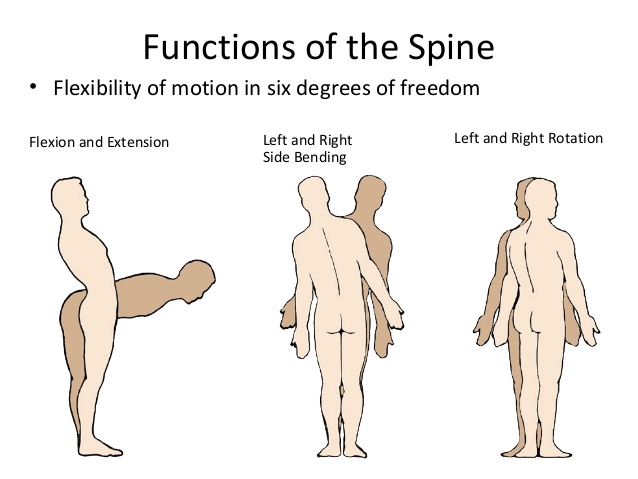
    Let’s dive into our second principle, mobility (stability is covered in Part 1 of this series). The definition of mobility is to move or be moved freely and easily. This means without difficulty and without pain. Movement comes from joints – the point where two bones make contact. Muscles contract and relax to move joints. Our nervous system, run by the brain, gives the command to our muscles to move or be still. The lumbar spine has on average, the following ranges of motion (in degrees). Notice that the lumbar spine primarily assists with spinal flexion and extension (sagittal plane or forward/backward movement) compared to the other motion types available to it. 

    Flexion 40-50º
    Extension 15-20º
    Rotation 5-7º 

    Lateral Flexion (side bending)

    20º


    spine-anatomy-basic-spine-2009-16-638

    Common barriers to full range of motion include joint restriction, muscle restriction, and motor coordination deficits. An example of each respectively include osteoarthritis, shortened muscle tissue from poor posture habits, and excessive movement from one segment – most commonly the L5-S1 segment vs uniform flexion-extension throughout the entire lumbar spine, L1-S1, due to learned poor motor behaviors and postural deficits. 


    Most often, extension is the first motion to be negatively affected. From the time we are born, we know the effects of gravity. Gravity pushes us into flexion, and over time we find ourselves slouching over computers, slumped on comfy couches, spending our days in flexed positions, thanks to gravity’s pull. Without training, over time we lose our ability to go into full lumbar extension. That loss of extension means that the balance of our gloriously complex musculoskeletal system is thrown off, leading to undue wear and tear. Imagine the gears of your bike were constantly rubbing in places they shouldn’t. Metal breaks down, gears get stuck, and seemingly overnight, the wheel doesn’t turn like it used to. But this wasn’t an overnight issue. It was years of breakdown because the gears were never addressed. This is what happens to the structures in your body. The seemingly sudden incident that throws out your back – waking up from sleep in sudden pain, sharp shooting agony after picking up a light bag from the floor – is really just the final straw to an issue that was building up for a very long time. 


    Issues like this can often be avoided with appropriate movement and posture education, training mobility, and most importantly adopting an overall healthy lifestyle. There is no easy fix to our orthopedic pains, unfortunately. As nonchalantly as medical providers offer us pills and creams to make our pain go away, these are only temporary relief aids to issues that only YOU have the power to heal. Our life choices affect our every cell. It’s true what they say – you are what you eat, and you are what you do. Isn’t it joyous to know that you have the power to change your own life? So, choose food, drink, movement, and stress reduction habits that will support your well-being and minimize your chances of developing avoidable chronic diseases, such as low back pain. 


    In summary, our lumbar spine moves in 3 planes of motion, but mostly it is responsible for flexion and extension. Over time, extension tends to be the primary motion of the lumbar spine that becomes limited due to gravity’s pull biasing flexion. To avoid losing extension, or any other motion of the lumbar spine, you can 1) educate yourself on appropriate posture and movement mechanics for your activities of daily living, 2) train mobility, and 3) support your movement practice with other healthy lifestyle choices. The LYT Daily platform is full of classes to support your lumbar spine mobility. Try one of these below and see for yourself! Your back will thank you. 


    1. LOW BACK MOBILITY | Beginner | with Kristin
    2. Better Backbending – A LYT Yoga® Workshop | with Lara


    Until next time, cheers to a happy low back! 


    XO, 

    Thalia Wynne, PT, DPT, AT, RYT-200 

    @thalialovee


    Picture source: https://www.themanualtherapist.com/2016/01/top-5-fridays-5-myths-about-spinal.html