Tag: education

  • 723. Wednesday Q&A: Cold/Heat, NeuroKinetic Therapy, & Piriformis Syndrome

    723. Wednesday Q&A: Cold/Heat, NeuroKinetic Therapy, & Piriformis Syndrome


    In this Wednesday Q&A, we answer your questions about to cool or heat an injury, neurokinetic therapy, and piriformis syndrome.


    Your questions:

    • In case of an injury, say muscle soreness or a twisted ankle, would you still recommend ice and cooling or moderate heat?
    • What are your opinions on NeuroKinetic Therapy as a modality of physiotherapy? There seems to be a divide in opinions, curious to know what you both think!
    • Piriformis syndrome – Can you explain what it is? Exercises to help out.


    To learn more, and for the complete show notes, visit: lytyoga.com/blog/category/podcasts/


    Do you have a question?


    Sponsors:


  • 718. Wednesday Q&A: Stepping Forward From Downdog, Hot Yoga, & Moves to Avoid with Osteoporosis

    718. Wednesday Q&A: Stepping Forward From Downdog, Hot Yoga, & Moves to Avoid with Osteoporosis


    In this Wednesday Q&A, we answer your questions about stepping forward successfully from downdog, the hot yoga craze, and moves to avoid with osteoporosis.


    Your questions:

    • I want to be able to step one foot forward form downdog into a low lunge. I can’t get my foot as far as my hands. Long legs? Short body? I don’t know. What can I do to develop this skill? Strengthen hip flexors? Core? I don’t even know what to work on and it’s a basic move. Feels like my arms are too short and I can’t get my torso high enough for my leg to go through.
    • Can you expand on the hot yoga craze?
    • Are there any moves I should avoid or modify if I have osteoporosis?


    To learn more, and for the complete show notes, visit: lytyoga.com/blog/category/podcasts/


    Do you have a question?


    Sponsors:

    • Visit almondcow.co/shop and use code LARA for a discount off your purchase!
    • Check out and sign up for LYT Daily and The LYT Studio, including our 1-week FREE trial of each here: https://lytyoga.uscreen.io/
    • 20% off coupon code for LYT Daily: LYTPOD24
  • Work Well Series Ep. 6: The Paradigm Shift to Working Well

    Work Well Series Ep. 6: The Paradigm Shift to Working Well


    Welcome to our special Work Well Series, where we explore the importance of prioritizing employee well-being in the office!

    In this last episode of our series, Lara and Kristin recap their biggest takeaways from these conversations. From the incredible impact of kindness to the unwavering need for psychological safety in the workplace to the push towards mental health support for employees, these companies set the bar for a better employee experience. Technology was also apparent to get ahead of the curve for employee benefits, through platforms like Wellable and Modern Health. 

    Kristin and Lara also discuss the gaps they found, specifically incorporating more accountability for physical wellness. They offer insights on movement and how corporations can incorporate this into their well-being philosophy. Whether you’re an employee, employer, or wellness enthusiast, this conversation provides valuable takeaways for creating an exceptional work wellness culture.


    Resources for this episode:

    Modern Health – https://www.modernhealth.com/ 

    Wellable – https://www.wellable.co/ 

    Beekman 1802 – https://beekman1802.com/ 

    Graduate Hotels – https://graduatehotels.com/ 

    TruWork Inc. – https://truworkinc.com/ 


    Connect with Lara Heimann, The Redefining Movement Podcast, and LYT Daily:


    Today’s podcast sponsor:

    LYT Daily/Prime – Check out and sign up for LYT Daily and LYT Prime, including our 2-week and 1-week FREE trials, here: https://lytyoga.uscreen.io/ 


    Follow the podcast:

  • Work Well Series Ep. 4: The Power of Education on Well-being in the Workplace

    Work Well Series Ep. 4: The Power of Education on Well-being in the Workplace


    Welcome to our special Work Well Series, where we explore the importance of prioritizing employee well-being in the office!


    This episode uncovers the extraordinary results when a company invests in redefining success through unwavering dedication to ongoing education and development for their employees.

    Lara talks with Kevin Osterhaus, President of Graduate Hotels about his vision of empowering individuals through the hotel chain’s unique Graduate Academy program. The program offers an innovative approach to education as a benefit of being an employee, allowing all staff to pursue continuing education degrees and certifications paid for by the company. Kevin discusses the powerful impact and positive effects that providing this type of holistic support for team members,has had on the on overall well-being of employees. 

    Graduate Hotels are an unapologetically unique brand that is a collection of one-of-a-kind hotel experiences focused around the college towns that they are located. Dedicating a portion of their benefits to surround continuing education not only aligns with the brand, but offers a clearly unique and positive experience for all of their employees. 


    Connect with our guest:

    Connect with Lara Heimann, The Redefining Movement Podcast, and LYT Daily:

    Today’s podcast sponsor:

    LYT Daily/Prime – Check out and sign up for LYT Daily and LYT Prime, including our 2-week and 1-week FREE trials, here: https://lytyoga.uscreen.io/ 

    Follow the podcast:

  • 706. Turmeric Wisdom and Dosha Harmony with Dr. Shivani Gupta of Fusionary Health

    706. Turmeric Wisdom and Dosha Harmony with Dr. Shivani Gupta of Fusionary Health


    Shivani Gupta knows a thing or two about the intricate world of supplements. She is a best-selling author with a PhD in Ayurveda medicine focusing on turmeric.

    In this episode, Lara speaks with Dr. Gupta about her own turmeric-based supplement line and addresses the need for trust and efficacy in an unregulated industry. 

    She explains the significance of understanding your dosha to achieve balance and overall well-being with Ayurveda’s holistic approach and Shivani’s advice for incorporating turmeric into daily life. 

    Throughout the podcast, Shivani shares the power of natural, authentic self-care methods against the backdrop of modern medical practices, inviting listeners to explore the synergies of Ayurveda and functional medicine.


    In this episode, you will learn the following:

    • Why the quality and regulation in the supplement industry are significant concerns. 
    • How the ancient practice of Ayurveda provides a foundation for understanding and addressing health issues such as inflammation and emotional well-being. 
    • Where to find your dosha type and tips to bring it into balance.


    Guest Resources:

    Connect with Lara Heimann, The Redefining Movement Podcast, and LYT Daily:

    Today’s podcast sponsor:

    Herbal Face Food: All natural vegan magic for your skincare routine! Use code LARA20 for 20% off your purchase.


    Follow the podcast:

  • PT Concepts You’ll Learn in the LYT Method Level 1 (200-Hour) Teacher Training

    PT Concepts You’ll Learn in the LYT Method Level 1 (200-Hour) Teacher Training

    PT Concepts You’ll Learn in the LYT Method Level 1 (200-Hour) Teacher Training


    One of the major benefits of the LYT Method Level 1 (200-Hour) Teacher Training is that you have the opportunity to learn a number of key physical therapy concepts. Because this method is designed by physical therapist Lara Heimann and the movements are filtered through the physical therapy lens the intelligence of physical therapy and its viewpoint on how to move your body well is seamlessly interwoven throughout. This teacher training allows you to incorporate these concepts into your knowledge and personal practice to better understand and communicate how your body is meant to move in order to be and feel at its best. This is a very empowering process that has a practical impact on your life and the lives of anyone you might work with. 


    Below is a list of some of the main physical-therapy-derived concepts that are an essential part of the LYT Method and that you will have the opportunity to learn and explore during the training. This is not a comprehensive list, but it’s a great starting point.


    Neutral Pelvis & Spine – Being able to understand what it feels like to have your pelvis and spine in a neutral position is a foundational concept to good movement. Although it may seem straightforward on its surface, this concept has a lot of nuance, and being able to find neutral in dynamic movement is not easy, but doable and worth the effort. Learning what neutral means and how to find it in your body and then intentionally move in and out of it when necessary will hold you in good stead for the rest of your life. 


    Deep-dive into anatomy – Understanding your own anatomy is an important aspect of developing a deeper connection to ourselves and to humanity writ large. This teacher training provides you with the anatomy and anatomical concepts that you need to be able to appreciate what is happening on a much deeper level on the inside while you move around your mat. 


    What is the core? – In common parlance, when we say “core” we are typically referring to our abs. But, from a physical therapy standpoint, the core includes everything from the outer shoulders to the base of the pelvis, your entire torso. Learning everything that is involved in your core and how to best utilize its engagement to your advantage in movement, is another key concept you’ll be exposed to. 


    Functional Training – We hear a lot about functional training in the fitness and movement industry these days. But what does that mean? Functional training is training for life, it is training for optimally performing the types of movements you do on a daily basis so that when you go to do them you do them in a way that doesn’t hurt you and that promotes the long-term health and well-being of your body. In the LYT Method, functional training is woven into everything we do. We all deserve this kind of training so that we can stay healthy and strong for as long as possible. 


    Neurodevelopmental Sequence – In every LYT Method class we start with “the reset” which incorporates the neurodevelopmental sequence to help us reset our body back to a more neutral starting point, so we can begin to layer on more complex movements. This sequence is based on the normal movement progression that babies follow as they learn to roll, sit, crawl, stand, and then walk. It is used in clinical settings to help patients learn proper movement strategies and it allows you to establish these strategies as the foundation of your movement practice so that you can move successfully in any number of ways. 


    Neural Mapping – You’ll explore the concept of neural mapping or brain mapping. Over time, our brains wire to fire a certain way and we end up doing movements in the way that we’ve habitually done them. But these movement patterns aren’t always optimal. In the LYT Method, we create opportunities for you to refine your movement patterns and then rewire your brain map through repetition throughout the class, through a process called neuro-muscular rewiring. This process is how you change your movement patterns to better support you over the long haul. 


    Mobility, Stability, & Adaptability – LYT Method movement will allow you to achieve mobility, stability, and adaptability in all of your movements and across all of your body. To have a resilient body, you want to have all three of these components present. The LYT Method sets you up to be mobile where you need it, strong when you need it, and to adapt to whatever comes your way with aplomb. 


    Find out more about our upcoming LYT Method Level 1 Teacher Training here! Registration opens Sunday, August 13, 2023 and the course starts Sunday, September 17, 2023.

  • Scapular Stability

    Scapular Stability

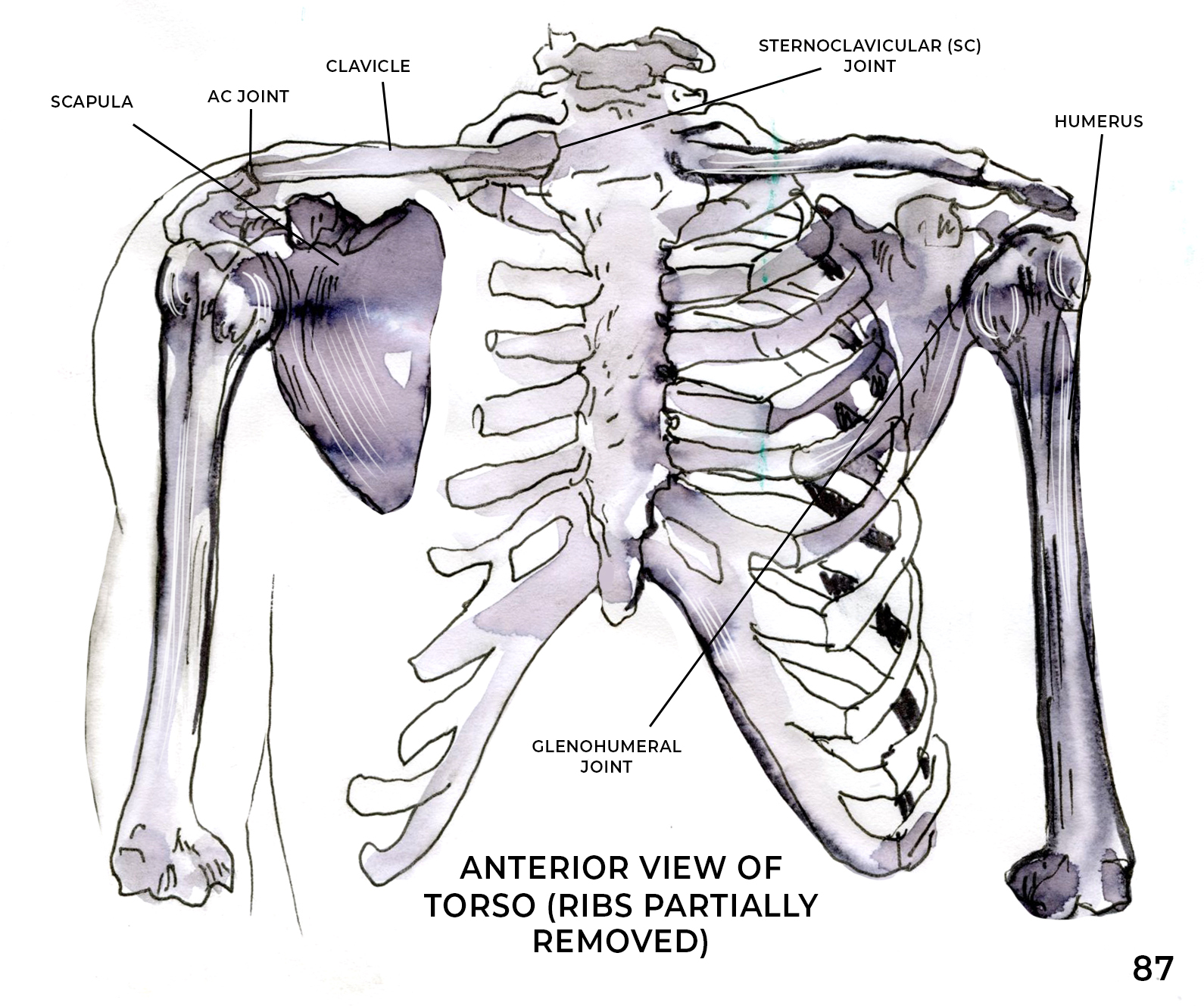
    When most people think of the shoulder joint, they usually only consider the space where the ball of the upper arm bone (humerus) articulates with the socket of the shoulder blade (scapula). In fact, most people don’t even know the socket is part of the scapula. Furthermore, calling the shoulder a “ball and socket” joint is a stretch, as it’s really more like a golf ball sitting on a tee. The socket is actually a small shallow disc (glenoid fossa). The ball (humeral head) is held in place passively by ligaments of the joint capsule and actively by the muscles of the rotator cuff. But the shoulder itself is really more of a “complex”, consisting of four separate joints that must work together to keep the shoulder complex functioning properly:


    1. Glenohumeral Joint – Humerus and Scapula
    2. Acromioclavicular Joint – Scapula and Clavicle (collar bone)
    3. Sternoclavicular Joint – Sternum (breast bone) and Clavicle
    4. Scapulothoracic Joint – Scapula and Rib Cage


    Unlike most joints of the body in which two bones are connected by ligaments and/or discs, the scapulothoracic joint relies purely on a coordinated dance of 17 muscles that attach to the scapula, as well as the mobility of the other three joints, to provide stability for the rest of the arm and shoulder. SEVENTEEN MUSCLES!!! Weakness in any one of the muscles attaching to the scapula, but particularly the large ones like the serratus anterior (Lara’s favorite!), latissimus dorsi, trapezius, and rhomboids, can affect how the shoulder and ultimately the entire upper extremity moves and functions. Poor movement patterns, muscular weakness, and limited joint mobility can lead to pain in and injury to the neck, shoulder, spine, elbow, wrist, and hand.


    Whether you are playing a racquet sport, doing yoga, or just trying to put away the dishes in an overhead cabinet, scapular strength and mobility are key to preventing injury. Weakness in these large “core” muscles can lead to overuse of the smaller muscles of the upper extremity and thereby cause injuries.


    The muscles of the scapula form force couples, which are muscular co-contractions that properly position the scapula for maximum shoulder function and provide a stable base of support for the entire upper extremity. It has been estimated that throughout 90% of shoulder range of motion, muscles (and not passive structures) are responsible for shoulder stability. Scapular issues are commonly seen in people with tight and overactive upper trapezius and pectoralis minor muscles, coupled with weak/underactive lower trapezius and serratus anterior muscles. This decreases the ability of these force couples to occur, resulting in decreased static and dynamic positioning (stability) of the scapula during movement.


    Corrective exercises can be very successful in restoring neuromuscular control of the scapula, helping to return to normal function and enhancing the overall function of the shoulder complex. An exercise program should include proximal kinetic chain exercises aimed at improving scapular muscle strength, flexibility exercises to minimize tight muscles pulling the scapula out of position, and exercises to enhance these functional force couples. In Lara’s podcast, Redefining Yoga, Episode 269 Wednesday Q & A, she describes some great ways to improve your scapular strength and stability. We will also be featuring some classes focused on the scapula in this week’s upcoming LYT® Daily, so be sure to check it out! One of the best places to begin to strengthen and stabilize the scapula is on your mat. I look forward to seeing you there!


    Xoxo,

    Kristin