People often ask me for tips on how to find more balance in their lives. While many factors contribute to that feeling of physical and mental equilibrium that can be considered balance, I often tell people to start by examining how they carry themselves. Posture is an indicator of both external and internal stability. And, in my opinion, posture is an essential gateway to discovering more balance in your body, mind and energy.
So, how does one find the most optimal posture? Just like almost everything in life, there is no “perfect”. But, there exists a spectrum of balance in which we are able to hold ourselves upright with more ease and efficiency; and with more optimal posture, we move in a variety of positions with less effort and a decreased chance of injury. It makes sense that we will therefore have more energy if we expend less effort like we do when we are misaligned. Compensations in the muscular firing cost us energy. So, let’s look at how we can improve our posture to hold on to more of our life fuel.
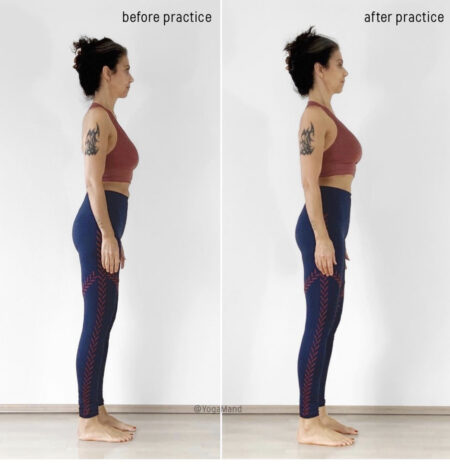
Start by examining your standing posture. When you are standing, your head should be centered over the neck, resulting in an imaginary line where your ears bisect your shoulders. In this modern day of technology, far too many people carry their heads off-center where their ears are way in front of the shoulders. This forward head position indicates that the head is not balanced over the cervical spine, the neck. The neck will then not be evenly balanced over the torso (as it should be in more optimal posture, with the shoulders centered over the pelvis). The pelvis is often pitched forward which could either be because of the neck or because of the increased time we spend sitting or both.
To get a sense of this in your own brain mapping, stand against a wall with the back of your skull, scapulae (shoulder blades), and sacrum (the lowest part of your back) touching the wall. In the more optimal standing posture, all the natural curvatures in the spine will be in place, with the cervical and lumbar spine not touching the wall. Notice what part of those three areas -skull, scapulae and sacrum – have a harder time connecting to the wall. This sensory feedback will let you know where your are not balanced. For example, I have seen people struggle to get the back of the skull to touch the wall, indicating that the neck muscles in the back are restricted and the anterior/front muscles of the neck and torso are probably weaker. If the sacrum has a hard time connecting with the wall, the muscles in the front hip could be tight and tipping the pelvis forward. Even though many factors can contribute to the overall imbalance of posture, learning to “find” a more optimal position with the feedback of the wall can help the underlying issues.
Your posture won’t change overnight, but you can work on it with the feedback of the wall, reorienting that upright position and getting a sense of what muscles will need to strengthen or lengthen to help with standing tall. This search and work for physical balance will not only help you stand taller, it will also help you identify areas of misalignment in your body that can be improved by first becoming aware that they exist. Awareness is the first step to changing the way we stand and move to lead us to more balance in our energy and in our movement.