Tag: anatomy

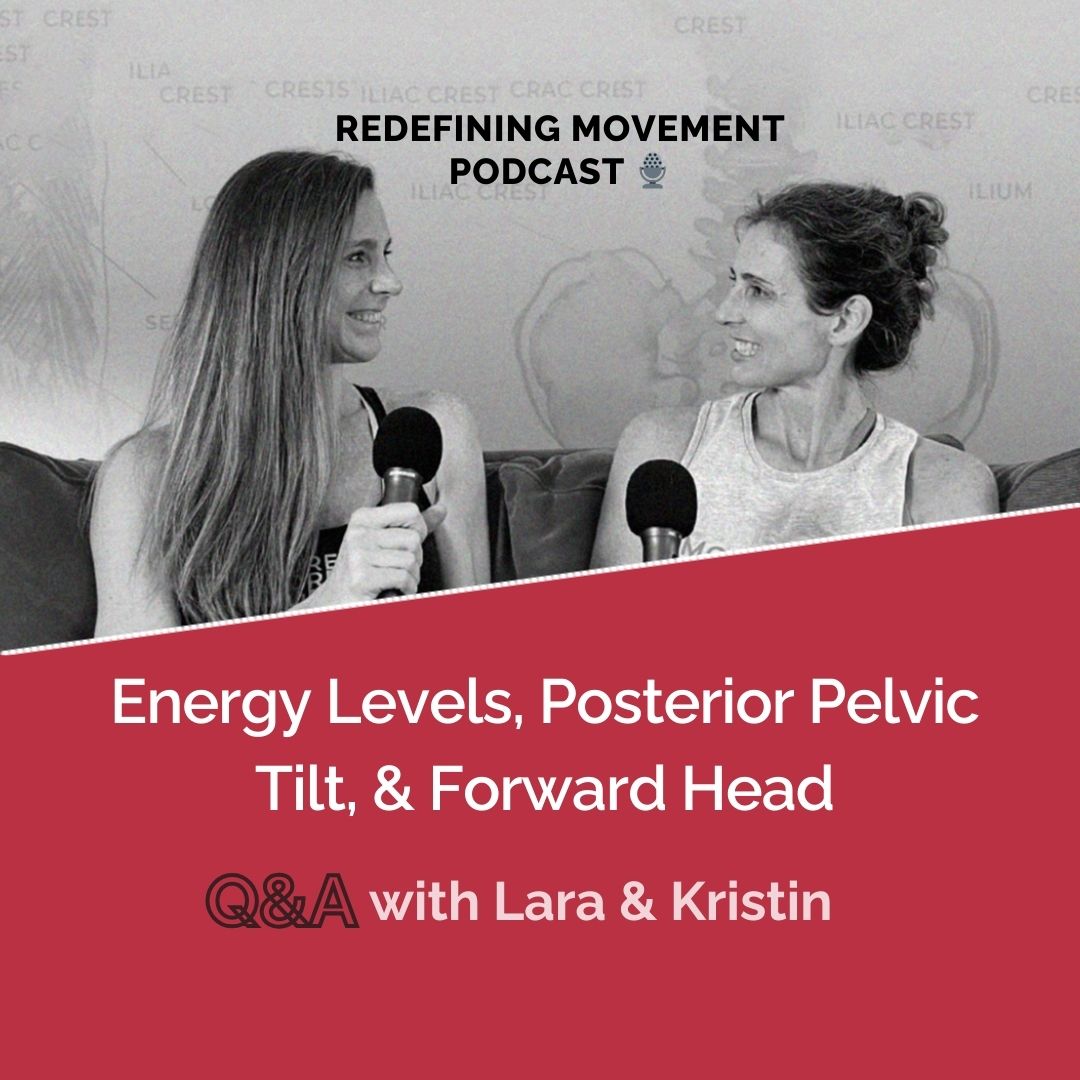
  • 721. Wednesday Q&A: Energy Levels, Posterior Pelvic Tilt, & Forward Head

    721. Wednesday Q&A: Energy Levels, Posterior Pelvic Tilt, & Forward Head


    In this Wednesday Q&A, we answer your questions about high energy levels, how to correct a posteriorly tilted pelvis, and forward head and neck hump help.


    Your questions:

    • You two seem to have a lot of energy, share the secret sauce.
    • I’ve wound up over correcting my anterior tilted pelvis and created a slight posterior tilt. What would you both recommend to correct this?
    • My forward head is getting worse. Why do I have a neck hump and what can I do to get rid of it?


    To learn more, and for the complete show notes, visit: lytyoga.com/blog/category/podcasts/


    Do you have a question?


    Sponsors:

    • Visit almondcow.co/shop and use code LARA for a discount off your purchase!
    • Check out and sign up for LYT Daily and The LYT Studio, including our 1-week FREE trial of each here with this exclusive 20% off coupon code (LYTPOD24): https://lytyoga.uscreen.io
  • 14 | Anatomy of Movement: Pelvis, Glutes, Feet, & More | John Frank, PT

    14 | Anatomy of Movement: Pelvis, Glutes, Feet, & More | John Frank, PT

    Today I welcome my brother, John Frank, back on the podcast. John is a physical therapist and movement specialist. (If you haven’t already, listen to John’s first episode!) I wanted to have John back on to answer questions that were sent in by you, and to further discuss movement and anatomy.

    What are some recommendations you’d make for runners?

    Start easy, start small, and let your body adapt to the new stresses.

    Paying attention to your balance and the form of your pelvis, as well as where your knees are going, is extremely important. By practicing a single leg stance, you can better prepare your body for the stress of running.

    What do you recommend for foot pain? What are the biggest causes of foot pain?

    Not wearing proper shoes, or having them available to you, is a main reason people have foot pain. Your body weight goes into your big toe the most, and it really needs to be in alignment with the rest of the arch and inner foot. When it’s pushed inward, your kneecaps become useless because your body weight isn’t being properly placed. A lot of the time, the pain can be alleviated by simple practices, such as recognizing postures and movements.

    What are things that are great for the lower back in yoga, and maybe not so great?

    “People with low back pain tend to have weak and/or stiff hips.”

    Maintaining a more stable low back, while opening up your hips, and keeping a neutral spine while in the transitions is very important in yoga. Women tend to hyperextend, and push their pelvis forward, so this is something to pay special attention to, especially if you are experiencing back pain.

    Resources:


  • 10 | Neutral Pelvis: The Secret to a Strong Yoga Practice & Life

    10 | Neutral Pelvis: The Secret to a Strong Yoga Practice & Life

    A neutral pelvis is so important for our movement patterns and for our energy level, and that’s why today’s episode is all about creating and maintaining a neutral pelvis.

    What does “pelvis” mean? Where is the pelvis?

    In Latin, pelvis translates to “acetabulum” meaning, basin.

    The pelvis is where your lower limbs come up and meet at the hip joint. The illium, the pubic bone, the sacrum, and the tailbone all meet to create the pelvis. The tailbone actually serves as an attachment point for the lower muscular system.

    What is a neutral pelvis?

    The pelvis provides the foundation for the spine. When thinking about energy exchange and how we hold onto energy within the body, a neutral pelvis is fundamental for that. If you go against a wall and find your sacrum, pushing that against the wall will help you see where your pelvis aligns. If you find that it’s difficult, this probably means the front of your hip is tight and you have an anterior tilt.

    Why is it important?

    A neutral pelvis is important in supporting the spine, this way no excessive strain is placed on your spinal cord. It is also important for proper joint movement, and fundamental for taking big, deep breaths.

    Neutral Acronym:

    • N: Neck in line
    • E: Elongate
    • U: Un-clench your jaw
    • T: Tailbone down
    • R: Ribs broaden
    • A: Abdominals drawn together
    • L: Line between the pubic bone and tailbone


  • 3. Evolution of a Yoga Practice with John Frank, PT

    3. Evolution of a Yoga Practice with John Frank, PT

    I want to introduce all of you to an exceptional physical therapist, a movement specialist (yoga), and a biomechanical, anatomical wonder: my brother John Frank (who is just one of my brothers because we’re triplets)!

    Physical therapy is a satisfying vocation because they get to spend a lot of time with the people we help and their main function is to educate – which also means they have to be constantly educating themselves.

    And if there’s one person I’ve learned the most from, it’s definitely John!

    Since people often send me questions about yoga, today I ask John these questions so we can get a physical therapist’s perspective on various aspects of yoga and movement. And if you have any questions, feel free to send me a DM on Instagram (@lara.heimann).

    What’s up with deep forward folds?

    John says, “It’s a mechanism for herniating your disc.”

    I don’t teach them in my practice and I suggest you avoid them, especially while sitting. Plus, they’re boring! If you think it feels good, that’s because you’re stretching out other stuff, like your fascia, and there are healthier ways to do that. As John says, “A temporary feel good doesn’t necessarily mean good for you.”

    How do you get more improved body awareness, other than yoga?

    “It’s very tricky,” John says. Your posture adapts to how you move (or don’t) and it starts to feel normal. But for the most part, external cues are better than internal cues. “If you overthink what’s happening in your body … your body is not good at getting those cues.”

    So if you’re running, for instance, don’t focus on what you want your body to be doing. Instead, let your nervous system do most of the work and, if you have to focus on something, listen for a noise when your foot hits the ground and adjust until it’s not a loud thud.

    It can even be as easy as putting a sticky note at your desk reminding you to straighten your posture. The goal is to just bring awareness without overthinking things!

    Besides running, what movements does John enjoy? What would he suggest for himself or other people?

    “A variety of movement is good, but everyone should be doing their equivalent of a deep squat … because everyone squats, whether you know it or not!”

    There’s also walking – “an underrated activity.” We were born to walk, plus it’s just a pleasant thing to do!

    And it’s a little bit of a cop-out, but he’s my brother so I’ll allow it: incorporate a variety of movement. Have fun, play games, whatever. Just do different activities!


    To learn more, and for the complete show notes, visit: lytyoga.com/blog/category/podcasts/


    Connect with LYT Yoga and Lara Heimann:

    Instagram Lara Heimann – https://www.instagram.com/lara.heimann/

    Facebook Lara Heimann – https://www.facebook.com/lara.f.heimann

    Instagram LYT Yoga – https://www.instagram.com/lytyogamethod/

    Facebook LYT Yoga – https://www.facebook.com/lytyogamethod
     

  • 1. Redefining Yoga for Our Modern Lives

    1. Redefining Yoga for Our Modern Lives


    Good movement, everyone! Welcome to Redefining Yoga, a podcast designed to investigate all aspects of the modern evolution of yoga. My name is Lara Heimann and I am a movement specialist, yoga studio owner, loving mother of two, proud vegan, and your host!

    My mission is to help everyone listening find freedom through smarter and safer movement patterns so that, together, we can be uplifted, benefitting all beings around us.

    To start our journey into movement, I want to share more about who I am, why I feel compelled to bring movement to the masses through Movement by Lara, and how we’ll be redefining yoga throughout this show. 

    I want to be clear – I’m not trying to change yoga at all! Yoga is and always has been wonderful, and the essence of it always remains the same: raising consciousness. I just want to examine the box we’re putting yoga into and explore ways to change or improve the way we’re living. 

    Because when you look critically at some of the movements in yoga, you’ll see they’re actually not great for the human body. This is why I really believe in teaching Smart Yoga, in which we always ask the question, “Does this feel right for what our modern culture needs?”

    So are you ready to join me in exploring, on our mats and in our lives, different ways of moving better, feeling better, and making our movement count?

    To learn more, and for the complete show notes, visit: lytyoga.com/blog/category/podcasts/

    Connect with LYT Yoga and Lara Heimann:

    Instagram Lara Heimann – https://www.instagram.com/lara.heimann/

    Facebook Lara Heimann – https://www.facebook.com/lara.f.heimann

    Instagram LYT Yoga – https://www.instagram.com/lytyogamethod/

    Facebook LYT Yoga – https://www.facebook.com/lytyogamethod